Property Taxes in Europe: A 2026 Country-by-Country Guide for Modular Home Buyers
Quick Answer
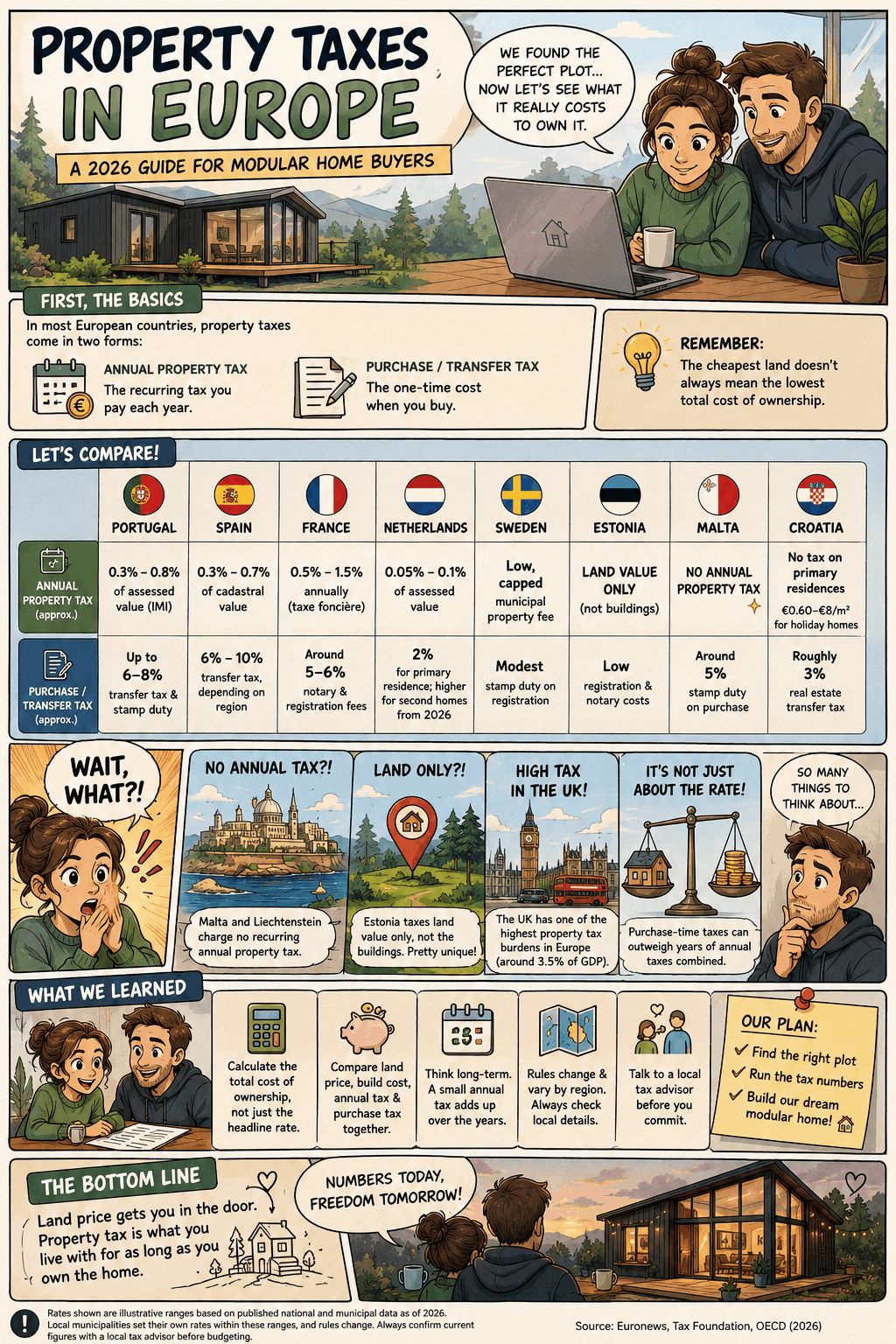
Property taxes in Europe vary more than most buyers expect. Some countries, like Malta and Liechtenstein, charge no annual property tax at all. Others, like the UK and France, tax ownership every year but keep purchase costs comparatively lower. The country with the cheapest land isn’t always the country with the lowest total cost of ownership — and that’s the number that actually matters once you’ve moved in.
Key Takeaways
- Property taxes in Europe come in two main forms: an annual tax on ownership and a one-time tax paid at purchase, and countries balance the two very differently.
- Malta and Liechtenstein charge no recurring annual property tax at all.
- The UK has one of the highest property tax burdens in Europe relative to GDP, while the Netherlands and Switzerland sit near the lowest.
- Estonia is the only European country that taxes land alone rather than land plus buildings, an unusual structure worth knowing if you’re comparing plots.
- The purchase-time tax bill can outweigh years of annual property tax combined, so total cost of ownership matters more than any single headline rate.
If you’ve spent any time comparing the cheapest countries in Europe to buy land for a modular home, you’ve probably already done the math on land prices per square meter. Property tax is the number that keeps showing up after you’ve moved in, and it’s the one most comparison guides skip entirely.
Why Property Taxes in Europe Matter More Than the Sticker Price
A cheap plot of land in a low-tax-headline country can still cost more over ten years than a pricier plot somewhere with a lighter annual tax bill. That’s the part of the calculation buyers tend to miss when they’re focused on land cost or build cost alone.
Modular home buyers are especially exposed to this. You’re often choosing a country specifically because land is affordable, and if the tax structure eats into that advantage year after year, the math you did on day one stops holding up by year five. Understanding the tax landscape upfront means you’re comparing what you’ll actually pay, not just what you’ll pay at closing.
The Two Types of Property Tax You’ll Actually Encounter
Before comparing countries, it helps to know what you’re actually comparing. European property tax generally comes in two forms.
Annual property tax is the recurring bill, charged every year based on your property’s assessed or cadastral value. It goes by different names depending on where you are — council tax in the UK, taxe foncière in France, IMU in Italy — but the function is the same: you pay it as long as you own the property.
Purchase or transfer tax is the one-time cost paid when you buy. This is sometimes called stamp duty, registration tax, or transfer tax, and in some countries it’s replaced or supplemented by VAT on new construction.
There’s a third category, capital gains tax on sale, but that only applies when you eventually sell, and most countries reduce or exempt it for a primary residence held long enough. It’s worth knowing it exists, but it’s a separate conversation from what you’ll budget for while you actually own the home.
Property Tax Comparison: 8 Popular Countries for Modular Homes
Here’s how annual and purchase taxes compare across countries that come up often in modular home planning.
Portugal
Annual Property Tax: Roughly 0.3%–0.8% of assessed value annually (IMI)
Purchase / Transfer Tax: Up to 6-8% combined transfer tax and stamp duty
Spain
Annual Property Tax: Roughly 0.3%–0.7% of cadastral value annually
Purchase / Transfer Tax: 6-10% transfer tax, depending on region
France
Annual Property Tax: Roughly 0.5%–1.5% annually (taxe foncière)
Purchase / Transfer Tax: Around 5-6% notary and registration fees
Netherlands
Annual Property Tax: Roughly 0.05%–0.1% of assessed value annually
Purchase / Transfer Tax: 2% for a primary residence; higher for second homes starting in 2026
Sweden
Annual Property Tax: Low, capped municipal property fee rather than a value-based tax
Purchase / Transfer Tax: Modest stamp duty on registration
Estonia
Annual Property Tax: Land value only, not buildings; among the lowest effective rates in Europe
Purchase / Transfer Tax: Low registration and notary costs
Malta
Annual Property Tax: No annual property tax
Purchase / Transfer Tax: Around 5% stamp duty on purchase
Croatia
Annual Property Tax: No tax on primary residences; €0.60–€8 per m² for holiday homes
Purchase / Transfer Tax: Roughly 3% real estate transfer tax
Rates shown are illustrative ranges based on published national and municipal data as of 2026. Local municipalities often set their own rates within these ranges, and rules change. Always confirm current figures with a local tax advisor before budgeting.
The Countries With No Annual Property Tax
Malta stands out here. There’s no recurring annual property tax at all, which sounds like an obvious win until you look at the other side of the ledger: buyers pay roughly 5% stamp duty at the point of purchase. According to Tax Foundation Europe, Liechtenstein is the only other European country that levies no recurrent property tax whatsoever. The tradeoff is straightforward. You pay more upfront and nothing every year after, instead of a smaller amount every year for as long as you own the home.
Whether that trade favors you depends on how long you plan to keep the property. Buy and hold for twenty years, and a zero-annual-tax country starts looking very attractive. Buy and sell within a few years, and the upfront cost may not pay for itself.
Why the Netherlands and Estonia Sit Near the Bottom
The Netherlands keeps its annual property tax remarkably low. In Amsterdam, residential property is taxed around 0.0577% of assessed value, a fraction of what you’d pay in France or Portugal on the same value of home. The tradeoff shows up at purchase instead, where the standard transfer tax runs higher, though a reduced rate applies for primary residences under a certain value.
Estonia does something almost no other European country does: it taxes land value only, not the buildings sitting on it. For a modular home buyer, that’s a genuinely useful quirk. The structure itself, however much you invest in the build, doesn’t add to your annual tax bill. Only the land underneath does. This is worth factoring in if you’re also researching whether foreigners can buy land in Europe, since Estonia is one of the more accessible markets for non-resident buyers.
Where Property Tax Hits Hardest
The UK carries one of the heaviest property tax burdens in Europe, measured as a share of GDP. According to Euronews, recurrent property taxes in the UK consistently hover around 3.5% of GDP, among the highest in the entire OECD. Council tax, combined with business rates on commercial property, makes real estate one of the more heavily taxed asset classes in the country. This isn’t a design flaw so much as a funding choice. UK local governments lean on property tax to pay for schools, waste collection, and policing more heavily than most of their European neighbors, who raise more revenue through income and consumption taxes instead.
France sits in a similar bracket. The taxe foncière has climbed in recent years, and reform discussions are ongoing in several other historically low-tax countries too. Property tax rates aren’t fixed forever, even in places that currently look favorable.
What This Means When You’re Budgeting for a Modular Home
Land price and build cost get most of the attention in early planning conversations, and for good reason — they’re the numbers you write a check for on day one. Property tax is the number that keeps showing up, quietly, every year after.
A simple way to think about it: take the annual property tax rate, apply it to your expected home value, and multiply by however many years you realistically plan to own the property. Add that to your purchase-time transfer tax. That total, not the headline percentage, is what actually belongs in your budget next to land and construction costs.
This matters more for modular builds specifically, because the speed and cost advantage of modular construction can get quietly offset if the country you’ve chosen carries a heavier ongoing tax load than you accounted for. Running both numbers, land cost and tax exposure, before committing to a country puts you in a much stronger position than comparing land prices alone.
FAQ: Property Taxes in Europe for Modular Home Buyers
Does property tax differ for a modular home compared to a traditional house?
Generally no. Most countries assess property tax based on the value and use of the finished structure, not the construction method. A few jurisdictions, like Estonia, tax land only, which works in a modular buyer’s favor regardless of build type.
Do I pay property tax before construction is finished?
In most countries, you owe land tax on the plot from the date you take ownership, whether or not a home sits on it yet. Once the home is completed and registered, the assessed value typically updates to reflect the finished structure.
Which country has the lowest total cost of property tax over ten years?
It depends heavily on property value and how long you hold it. Countries with no annual tax, like Malta, can work out cheaper over a long hold despite higher purchase costs. Countries with very low annual rates, like the Netherlands, can be cheaper for shorter ownership periods. Running both numbers against your specific timeline is the only reliable way to compare.
Is property tax the same for foreign buyers as it is for local residents?
In most European countries, yes, the property tax itself applies equally regardless of nationality. Some countries add extra transfer tax tiers for non-primary or investment properties, which can affect foreign buyers differently depending on how the property will be used.
Should I talk to a tax advisor before choosing a country?
Yes. Rates change, municipalities set their own variations within national ranges, and your personal residency status can affect what you owe. This guide is a starting point for comparison, not a substitute for advice specific to your situation.
Comparing Countries Means Comparing the Whole Picture
Land price gets you in the door. Property tax is what you live with for as long as you own the home. The countries that look cheapest on a land-cost comparison aren’t always the cheapest once annual tax is factored in over a realistic ownership timeline, and the reverse is just as often true.
If you’re weighing where to build, running the tax numbers alongside land cost is worth the extra hour it takes. It’s the difference between a budget that holds up in year one and one that holds up in year ten.