Downsizing for Retirement: Why More Empty-Nesters Are Choosing Modular Homes

Quick Answer
Downsizing for retirement no longer means settling for a cramped flat or an outdated bungalow. A growing number of empty-nesters across Europe are turning to modular homes to right-size their living space, unlock equity tied up in a large family home, and move into a property built specifically for how they actually live now. Modular construction offers a faster, more predictable, and often more affordable path to a smaller, smarter home than renovating or buying an older resale property.
Table of Contents
Why Downsizing Looks Different in 2026
For decades, the retirement playbook was simple: sell the big family home once the kids move out, buy something smaller, and pocket the difference. That calculation has gotten more complicated. Rising transaction costs and shifting stamp duty thresholds mean downsizing now requires more strategic planning than the straightforward path it once was.
Even so, the underlying motivation hasn’t changed. Many retirees are asking the same question their parents did: does it still make sense to maintain a large home built for a family that no longer lives there? For most, the honest answer is no.
The financial case remains compelling for the right circumstances. Downsizing can still release meaningful equity, cut monthly running costs, and simplify a lifestyle, though it now takes more careful number-crunching around fees and true net proceeds than it did a decade ago. You can read a fuller breakdown of these UK-specific financial mechanics in Hamptons’ 2026 downsizing guide. What has changed is that retirees are no longer willing to trade comfort or quality for a smaller footprint, which is exactly where modular construction has stepped in as a genuine alternative to the traditional resale downsize.
Right-Sizing, Not Just Downsizing
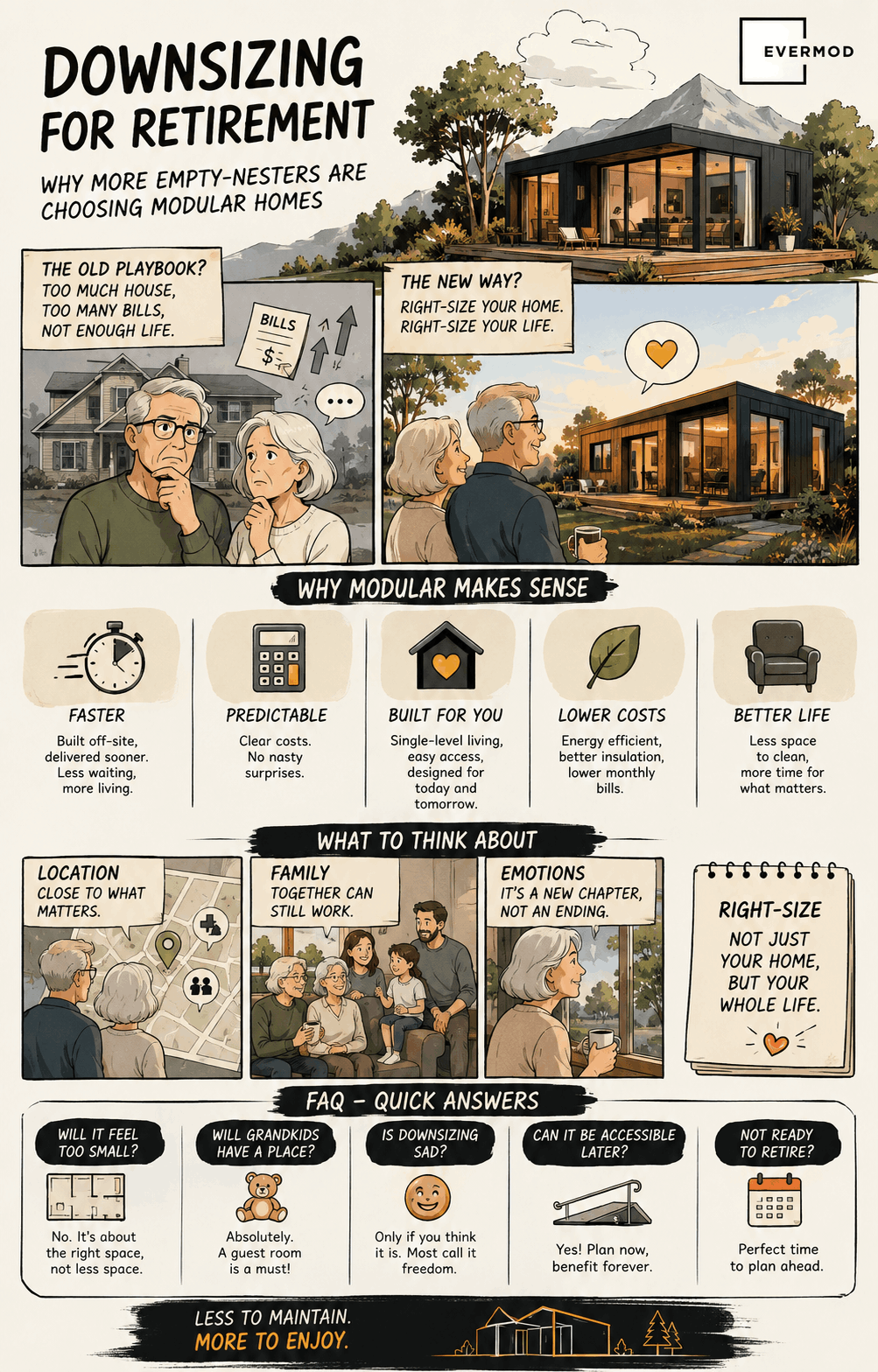
There’s an important distinction between downsizing and right-sizing. Downsizing implies loss: less space, fewer options, a step down. Right-sizing is about matching a home to a life stage, and for many retirees, that means trading square footage they never used for a layout that actually fits how they live day to day.
A modular home built for retirement can include everything that matters: a single-level layout, a step-free entrance, a well-designed kitchen, a comfortable guest room for visiting grandchildren, and none of what doesn’t: unused formal living rooms, oversized staircases, or bedrooms that have sat empty since the children moved out.
Why Demand for This Kind of Housing Is Growing
Demographic data across Europe backs up what many retirees already feel. Aging populations across the continent are driving continued demand for downsizing options, arriving at the same time younger buyers are entering homeownership for larger family homes. Many homeowners now treat their property as a form of supplementary retirement income, particularly when transitioning to a smaller home rather than a care facility. The Europe Residential Real Estate Market Forecast has more detail on how this shift is playing out region by region.
Why Modular Construction Fits the Downsizing Decision
Choosing to downsize is often the easy part. Finding the right smaller home is where most retirees get stuck. The resale market for well-designed, single-level, retirement-friendly homes is thin in many areas, and older bungalows often come with outdated insulation, layouts that don’t suit modern accessibility needs, and renovation costs that erase much of the equity gained from selling the family home.
Modular homes solve several of these problems at once
Speed. A modular home is built off-site while groundwork happens in parallel, which shortens the overall timeline compared to a custom renovation or new-build project. For someone who has already sold their family home, a shorter build time means less time spent in temporary housing or paying two sets of costs at once.
Predictable cost. Because modular homes are manufactured in a controlled factory environment, pricing is agreed upfront and is far less exposed to the material price swings and labor shortages that can derail a traditional renovation.
Purpose-built accessibility. Retirement doesn’t always mean immediate mobility needs, but it often means planning for them. A modular home can be designed from the start with wider doorways, zero-step entries, and single-level living, features that are expensive and disruptive to retrofit into an older resale property.
Energy efficiency. Smaller, modern, well-insulated homes cost less to heat and maintain, which matters directly to a retirement budget built around a fixed income.
If you want the broader demographic picture behind this shift, we’ve covered how Europe’s aging population is changing modular housing at a macro level. And for retirees thinking further ahead toward assisted living, our piece on how turn-key modular homes are improving senior care covers what that transition can look like when the time comes.
What to Think About Before You Right-Size
Location Still Matters More Than Size
A smaller home in the wrong location solves nothing. Before choosing a plot, think honestly about proximity to healthcare, family, and the kind of community life you actually want in retirement, not the one you think you’re supposed to want.
Multigenerational Living Is on the Rise Too
Not every retiree is downsizing alone. Higher home prices and elevated mortgage rates have pushed some retirees toward the opposite decision, using accumulated home equity to buy larger homes together with adult children instead of downsizing on their own. A financial adviser quoted in a recent ProgramBusiness industry report put it plainly: the decision has become as much about wealth transfer as it is about lifestyle. Modular construction accommodates this shift too. A larger modular home, or two connected units on one plot, can offer separate living space for aging parents and adult children without the compromises of a single shared household.
Don’t Underestimate the Emotional Side
Leaving a long-time family home is rarely just a financial decision. Many retirees stay in the family home longer than makes sense financially, often to the detriment of their own comfort and care needs, simply because leaving feels like both an emotional and financial barrier. A modular home that feels genuinely designed for this next chapter, rather than a compromise, tends to make that emotional transition easier.
FAQ: Downsizing to a Modular Home
Is a modular home actually smaller than a traditional house?
Not necessarily. Modular simply describes how a home is built, not how big it is. You can right-size into a modest one-bedroom unit or a spacious single-level home with room for guests. The point is designing for how you live now, not how many bedrooms felt necessary twenty years ago.
Will my grandchildren still have somewhere to stay over?
Yes, unless you’re planning to hide from them, which we don’t recommend. A well-designed modular retirement home can absolutely include a flexible guest room, it just won’t come with three empty bedrooms you’re heating and dusting for 51 weeks of the year.
Isn’t downsizing just… sad?
Only if you frame it that way. Ask anyone who’s gone from cleaning six rooms to cleaning two, and from a heating bill that could fund a small holiday to one that barely registers, whether they miss the extra square footage. Most don’t miss the space. They miss looking for the TV remote in it.
Can a modular home be built to be accessible later, even if I don’t need it now?
Yes, and this is one of the strongest arguments for building rather than buying resale. Features like zero-step entries and wider doorways cost very little to include at the design stage and a great deal to retrofit later. Planning ahead here is simply good sense, not pessimism.
What if I’m not ready to fully retire but want to start planning?
That’s arguably the best time to start. Right-sizing works best as a proactive decision made on your own timeline, not a reactive one made under pressure. The earlier you start exploring modular options, the more choice you’ll have over layout, location, and budget.