Climate Migration in Europe: Where Will People Move Next?

Table of Contents
For generations, Europeans have chosen where to live based on employment opportunities, family ties, lifestyle preferences, and economic prospects. Increasingly, however, another factor is beginning to influence those decisions: climate.
While climate migration is often associated with regions facing severe droughts, rising sea levels, or extreme weather events, the phenomenon is becoming increasingly relevant within Europe itself. Record-breaking heatwaves, prolonged droughts, catastrophic flooding, and growing water scarcity are changing how governments, investors, and homeowners think about long-term housing decisions.
Climate migration in Europe is still in its early stages, but the underlying drivers are becoming impossible to ignore. As climate risks reshape parts of the continent, some regions may become more attractive places to live and invest, while others face mounting pressure on infrastructure, insurance, and housing markets.
According to the European Environment Agency’s report on climate change impacts, risks and adaptation in Europe, Europe is now the fastest-warming continent in the world, with increasing exposure to heatwaves, floods, droughts, and wildfires. Traditional real estate decisions have largely focused on location, employment opportunities, and affordability, but climate resilience is quickly becoming part of the equation.
What Is Climate Migration and Why Is Europe Beginning to Experience It?
Climate migration refers to the movement of people caused, directly or indirectly, by environmental change. Sometimes that movement happens suddenly after floods, storms, or wildfires. More often, it occurs gradually as living conditions become less comfortable, more expensive, or less predictable over time.
Europe is already experiencing many of the pressures that can encourage relocation. Longer and more intense heatwaves are affecting southern regions, while severe flooding events have impacted parts of Central and Western Europe. Water scarcity is becoming a growing concern in several Mediterranean countries, creating challenges not only for agriculture but also for long-term residential development.
The conversation is no longer simply about environmental policy. It is increasingly about where people can comfortably live, work, retire, and invest over the next twenty to thirty years.
Recent heat events across Spain, Italy, Greece, and Portugal have demonstrated how climate conditions can directly affect quality of life. For many Europeans, climate resilience is gradually becoming a practical consideration rather than an abstract environmental concern.
Which Parts of Europe Face the Greatest Climate Risks?
Climate change will not affect every region equally. Some areas are expected to experience rising temperatures and water stress, while others may face increased flood risks or coastal vulnerability.
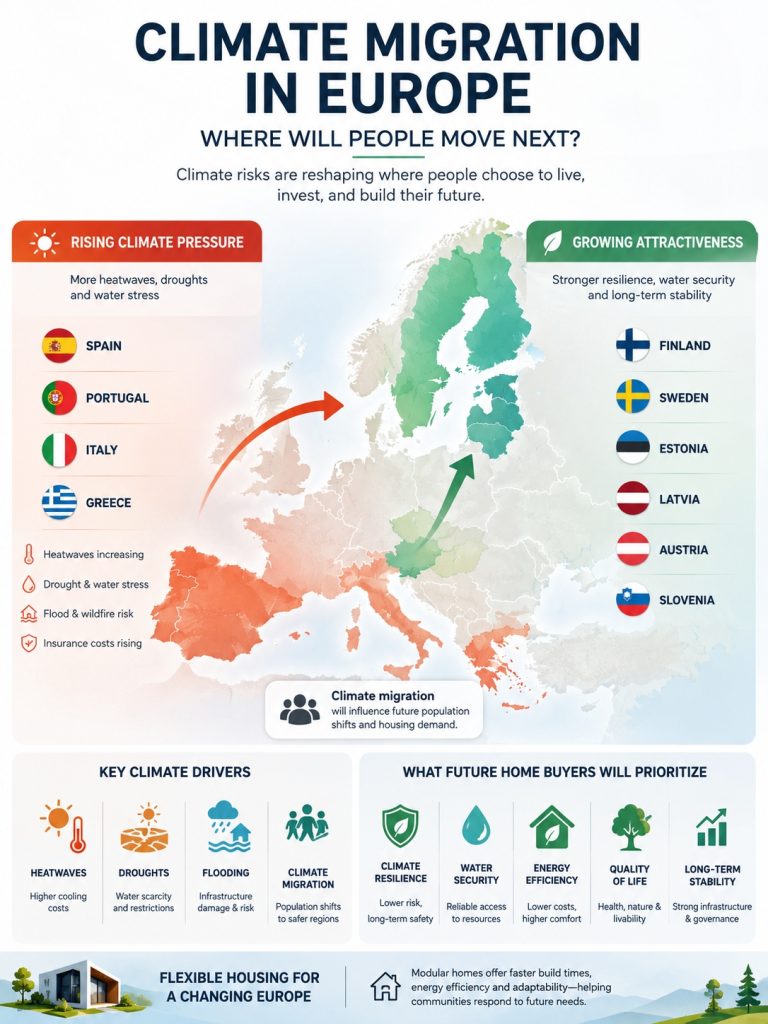
Southern Europe is widely considered one of the most exposed regions. Countries such as Spain, Portugal, Italy, and Greece are already experiencing more frequent heatwaves and prolonged drought conditions. In some areas, water shortages are becoming increasingly common, particularly during summer months.
Central Europe faces a different set of challenges. Heavy rainfall events, river flooding, and severe storms are becoming more frequent and costly. Infrastructure that was designed for historical weather patterns may increasingly struggle to cope with future conditions.
Coastal regions face additional uncertainty. Rising sea levels and stronger storm surges could place pressure on housing markets and infrastructure investments in vulnerable locations over the coming decades.
The result is not a simple north-versus-south story. Instead, Europe is entering an era where climate resilience may become just as important as access to jobs, schools, transportation, and amenities.
The Future Property Hotspots Emerging Across Europe
Whenever major demographic shifts occur, real estate markets tend to follow. As climate migration in Europe gains momentum, certain regions may become future property hotspots because of their relative resilience rather than their traditional popularity.
The Baltic states are increasingly attracting attention. Latvia, Estonia, and Lithuania combine relatively affordable land, abundant freshwater resources, expanding digital infrastructure, and moderate climate projections. These characteristics could become increasingly valuable as environmental pressures intensify elsewhere.
Scandinavia is frequently highlighted in discussions around climate resilience. Finland and Sweden benefit from extensive freshwater resources, strong infrastructure, renewable energy development, and lower exposure to extreme heat than much of Southern Europe.
Mountain regions such as Austria and Slovenia may also become increasingly attractive due to cooler temperatures and lower heat exposure while maintaining excellent connectivity to major European economies.
Many of these regions overlap with destinations already attracting modular home buyers. Our guide to the best countries to build a modular house in Europe explores how permitting systems, infrastructure quality, energy standards, and long-term stability influence where people choose to build.
These shifts do not mean that Southern Europe will suddenly become undesirable. Millions of people will continue to live and thrive there. However, climate resilience is likely to become a much more important factor in long-term property decisions, particularly for investors, retirees, and remote workers seeking stability.
Could Climate Migration Reshape European Real Estate Values?
Real estate has always been influenced by changing economic and social realities. Climate may soon become another major market force.
Historically, housing values have reflected access to jobs, infrastructure, education, and quality of life. In the future, factors such as flood exposure, water availability, insurance costs, and heat resilience may play a much larger role.
The European Environment Agency’s analysis of extreme weather, floods, droughts and heatwaves across Europe shows that climate-related hazards are already generating substantial economic losses across the continent. As weather patterns become more volatile, climate resilience is increasingly becoming an economic consideration as much as an environmental one.
For property buyers, this introduces a new layer of due diligence. The question may no longer be simply whether a location is desirable today. Increasingly, buyers will need to ask whether a location will remain desirable twenty years from now.
That is one reason why interest is growing in future property hotspots that combine affordability, infrastructure quality, and long-term climate resilience.
The Safest Places to Live in Europe as Climate Risks Increase
There is no perfect location immune to climate change. Every region faces its own risks and trade-offs.
However, when evaluating the safest places to live in Europe in relation to climate change, several factors consistently stand out. Water security, infrastructure quality, energy resilience, political stability, and lower exposure to extreme heat all contribute to long-term resilience.
Countries such as Finland, Sweden, Denmark, Estonia, Latvia, and Austria frequently perform well across multiple resilience indicators. These regions generally benefit from strong institutions, robust infrastructure, and lower exposure to some of the most severe climate hazards projected for Southern Europe.
Interestingly, several of these climate-resilient regions also appear in our analysis of the top countries in Europe for modular living, where infrastructure quality, energy performance, and long-term livability play a central role in housing decisions.
As climate considerations become increasingly integrated into real estate decisions, these characteristics may become more influential in determining future housing demand.
Why Flexible Housing May Become More Important Than Ever
Climate migration creates a practical challenge that extends beyond geography. Housing systems must be able to respond to changing population patterns.
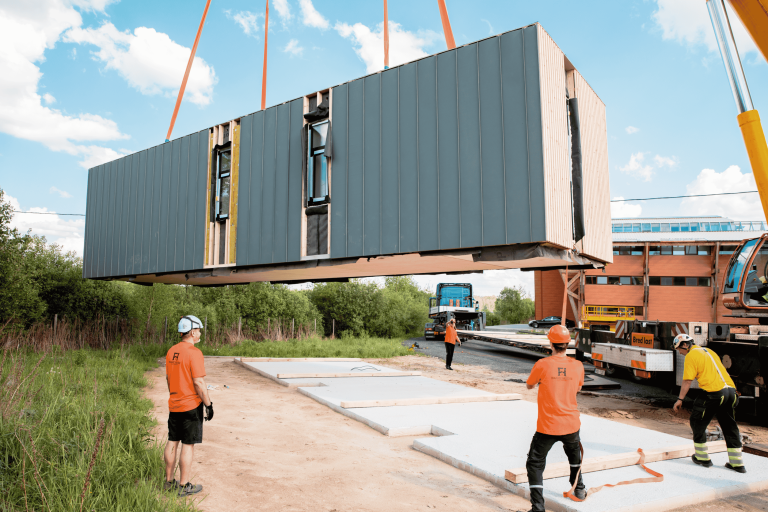
Traditional construction often requires years of planning, approvals, and on-site building. If demand shifts toward new regions, communities may need housing solutions that can be delivered more quickly and efficiently. This is where modular construction enters the conversation.
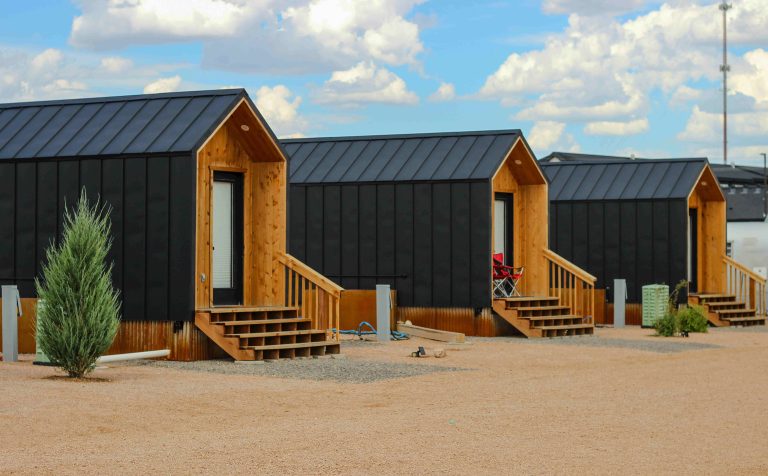
Rather than viewing modular homes solely as an alternative construction method, many planners increasingly see them as a flexible housing tool. Factory-built homes can be delivered faster, adapted to different climates, and designed to meet modern energy-performance standards.
As climate migration gradually reshapes housing demand, location suitability becomes increasingly important. Before purchasing land, it is worth understanding whether a particular region can realistically accommodate modular construction. Our guide on whether you can build a modular home anywhere in Europe explains how zoning laws, terrain, access, and local regulations can influence what is possible. As population movements become more dynamic, flexibility may become one of the most valuable characteristics in future housing.
Housing Must Adapt Faster Than the Climate
Climate migration in Europe is not a distant possibility. It is a gradual trend already beginning to influence housing markets, investment decisions, and regional development strategies.
While the pace of change remains uncertain, the direction is becoming increasingly clear. Climate resilience is moving from an environmental concern to a housing and economic consideration.
The regions that attract future residents may not necessarily be those with the lowest property prices or the warmest weather. Instead, they may be the places that offer long-term stability, reliable infrastructure, water security, and the ability to adapt to a changing climate.
For homebuyers, investors, and policymakers alike, understanding these trends early may become one of the most important housing decisions of the next decade. Those who consider climate resilience alongside affordability and lifestyle factors may be better positioned to make decisions that remain beneficial for years to come.
Frequently Asked Questions
1. What is climate migration in Europe?
Climate migration refers to people relocating because of environmental pressures such as heatwaves, flooding, droughts, wildfires, or declining living conditions linked to climate change.
2. Which countries are considered climate-resilient regions in Europe?
Countries often highlighted for climate resilience include Finland, Sweden, Denmark, Estonia, Latvia, and Austria due to their infrastructure, water security, and lower exposure to extreme heat.
3. What are the future property hotspots in Europe?
Potential future property hotspots include the Baltics, Scandinavia, parts of Northern Germany, Austria, and Slovenia, where climate resilience may support long-term housing demand.
4. How could climate change affect property values?
Climate risks may influence insurance costs, maintenance expenses, infrastructure investment, and overall housing demand, potentially affecting property values over time.
5. Are modular homes relevant to climate migration?
Yes. Modular homes can provide flexible, energy-efficient housing solutions that can be deployed more quickly in regions experiencing changing housing demand.
6. What should property buyers consider when evaluating climate risks?
Homebuyers should assess flood exposure, water availability, heat resilience, infrastructure quality, energy performance, and long-term climate projections before purchasing property.