Modern Modular Home Styles: What Your Choice Says About Your Personality
Table of Contents
For decades, buying a residential property was a series of rigid compromises. You chose a neighbourhood, accepted whatever floor plan was already built, and forced your daily routines into walls designed by a stranger. But the architectural landscape is shifting. The accelerating adoption of modern modular homes across Europe represents something much deeper than a trend toward rapid construction, it is a conscious psychological shift.
Today, choosing a home layout is an intimate act of identity design. Because factory-built structures are inherently adaptable, customisable, and clean, they act as an architectural canvas for our internal values. When you select a specific spatial blueprint, you are not just purchasing raw timber and steel frames; you are expressing your core psychology, your lifestyle goals, and your vision of the future.
The decision to transition into tailored, highly efficient properties often triggers a profound shift in mental clarity. In fact, scaling down and intentional curation directly match the internal psychology of living small, proving that shedding excess square metres and optimising layout architecture fundamentally makes us happier, calmer, and more focused.
Let’s pull back the insulation and explore what your favourite style of modern modular homes says about your internal blueprint.
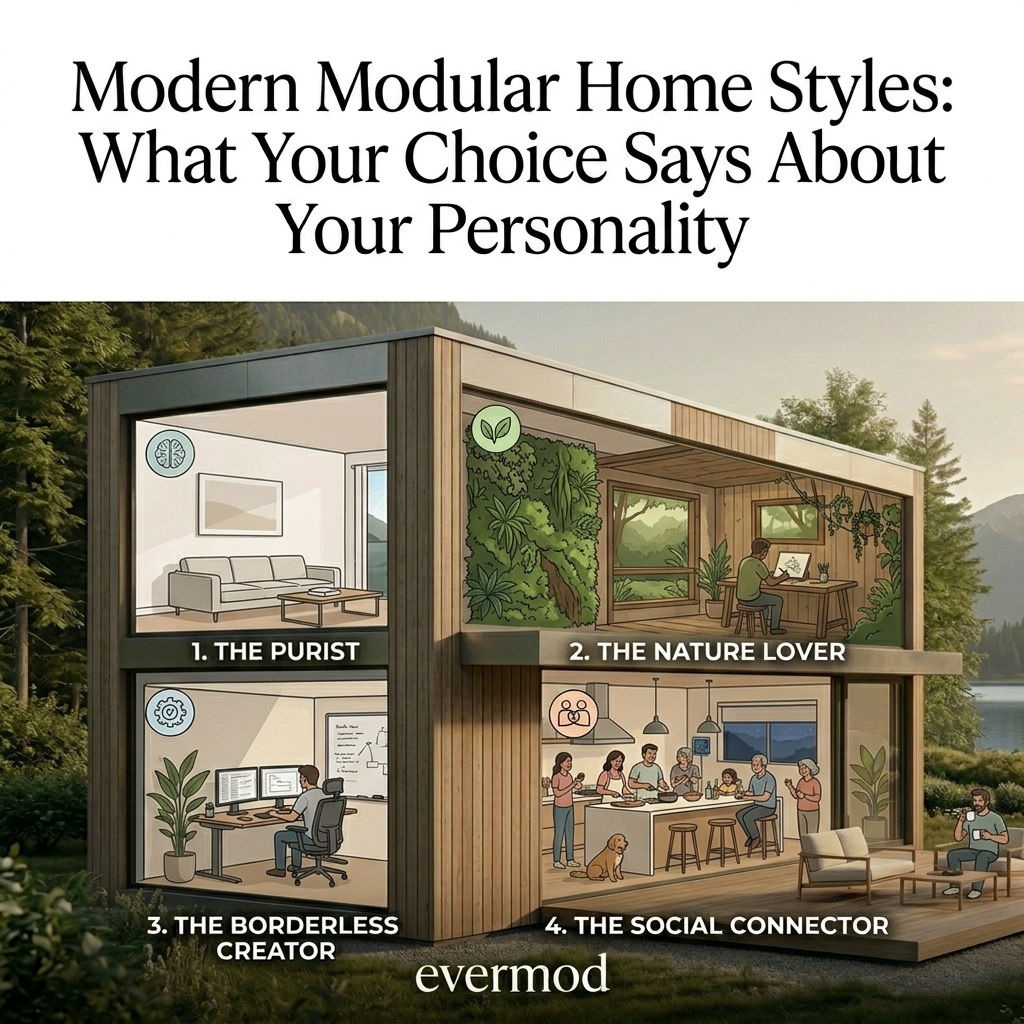
1. The Purist: Scandinavian Prefab Home Designs for the Minimalist Personality
If you gravitate toward minimalist aesthetics, clean lines, muted raw timber tones, and walls of seamless floor-to-ceiling glass, you are naturally aligned with the Purist archetype.
The Personality: Grounded, highly organised, and deeply protective of your mental energy. You are someone who gets easily overwhelmed by visual noise and physical clutter. You view your home as an emotional decompression chamber where the mind can reset after navigating a chaotic digital world.
The Spatial Connection: For the Purist, modern prefab homes designed with a distinct Nordic influence offer the ultimate psychological relief. Hidden, built-in smart storage systems keep your environment pristine, while expansive windows maximise raw daylight, effectively erasing the physical boundary between indoor shelter and outdoor nature. You don’t buy a home to show off wealth; you buy it to preserve your internal peace and focus.
2. The Nature Lover: Eco-Friendly Modular Cabins for the Environmentally Conscious
If your ideal residential layout includes off-grid readiness, sustainable materials, high-efficiency insulation, and a design that blends directly into a forest canopy or a rocky coastline, you belong to the Nature Lover archetype.
The Personality: Empathetic, introspective, and heavily environmentally conscious. You feel restricted by dense urban concrete jungles and value self-reliance, quiet isolation, and ecological stewardship above status symbols.
The Spatial Connection: You choose modern modular homes because you refuse to let your personal comfort come at the cost of the planet. Traditional building sites tear up local ecosystems and create massive resource waste.
According to the latest UNEP Global Status Report for Buildings and Construction, the building sector remains a primary driver of the climate crisis, responsible for massive material extraction and raw construction waste. By choosing precision engineering inside a controlled factory environment, you dramatically decrease your embodied carbon footprint. The eco-friendly cabin is a physical manifestation of your pledge to tread lightly on the Earth while enjoying uncompromised structural comfort.
3. The Borderless Creator: Prefabricated Garden Studios for Independent Thinkers
If you view residential spaces as dynamic engine rooms for creation, focus, and innovation, you naturally fall into the Borderless Creator category.
The Personality: Ambitious, highly independent, and fundamentally non-traditional. You don’t subscribe to the standard corporate 9-to-5 box, nor do you believe that work and life should be separated by a miserable gridlock commute. You require dedicated zones that induce rapid creative flow, but you need them to be entirely separate from your living room sofa or bedroom.
The Spatial Connection: Creators love modular systems because they solve modern spatial conflicts instantly. Adding a detached, soundproofed structural pod to an existing property creates an absolute boundary for focus. Your environment is your competitive advantage, and you design it accordingly.
Modern property owners are increasingly realising that factory-built modules can fulfil diverse operational needs. This versatility extends beyond simple housing; there are numerous surprising uses for modular spaces in modern life, ranging from detached commercial photography studios to personal wellness sanctuaries and localised tech labs.
4. The Social Connector: Open-Plan Modular Family Homes for Community-Centred Living
If your home exists primarily as a gathering place — a hub for family dinners, weekend hosting, and the kind of open-door warmth that makes guests reluctant to leave — you are the Social Connector archetype.
The Personality: Generous, expressive, and deeply relationship-driven. You measure a home’s success not by its square footage or its energy rating, but by the quality of the conversations it enables. You want flow between spaces, and you want every corner to feel welcoming rather than closed off.
The Spatial Connection: Modern modular homes with open-plan layouts, large kitchen islands, and seamless indoor-outdoor transitions are built precisely for this lifestyle. Because modules can be configured laterally rather than vertically, social connectors often choose wider single-storey designs that keep everyone on the same level — literally and socially. For you, a home is only as good as the people it brings together.
How Structural Flexibility Elevates Human Well-Being
Each of these archetypes is drawn to modular living for different reasons — but they all share one underlying need: control over their environment. And it turns out that control is not just a preference. It is a psychological necessity.
In fact, a landmark study published in the Journal of Environmental Psychology (2024) proved that a resident’s ability to easily change, modify, and adjust their living environment to suit evolving life stages is directly associated with significantly higher levels of long-term emotional well-being. Traditional brick-and-mortar homes are static, stubborn, and expensive to alter. Conversely, modern prefab homes are inherently dynamic. If your household expands, your remote career demands an office, or your lifestyle pivots toward minimalism, modular units can be expanded, reconfigured, or adapted with minimal friction. This architectural elasticity gives you ultimate control over your environment, reducing stress and enhancing your long-term quality of life.
What Is Your Design Blueprint?
Your home is the most personal design decision you will ever make. The question is no longer whether you can afford to build one, it is whether you are ready to build one that is actually yours.
Whether you seek the absolute isolation of an off-grid timber cabin, the stark visual peace of a Scandinavian villa, the focused utility of a backyard workspace, or the open warmth of a family gathering space, your home dictates your daily rhythm. By embracing modern modular homes, you step away from outdated, mass-produced housing standards and step into an intentional era of personalised, sustainable, and identity-driven living.
So — which archetype are you?
Frequently Asked Questions (FAQ)
- What does my modular home choice say about my personality?
Your choice often reflects how you like to live, work, and relax. Minimalist designs tend to appeal to organised, calm personalities, while open-plan layouts often suit social, family-oriented people. - Which modular home style is best for minimalists?
Scandinavian-style prefab homes are usually the best fit for minimalists. Clean lines, natural materials, and simple layouts support a calm and uncluttered lifestyle. - Are modern modular homes good for remote workers?
Yes. Modular homes can be designed with dedicated offices, garden studios, or quiet work zones, making them ideal for people who work from home. - Can modular homes be customised for different lifestyles?
Yes. One of the biggest advantages of modern modular homes is flexibility, so they can be adapted for family life, creative work, or sustainable living. - Are modern prefab homes energy efficient in European climates?
Yes. Modern prefab homes are often built with strong insulation, airtight construction, and energy-efficient glazing, which makes them well suited to European climates.