Why Europe’s Aging Population Will Change Modular Housing by 2030

Table of Contents
Europe’s housing market is changing in a way that goes far beyond interest rates or short-term market cycles. Europe’s Aging Population Will Change Modular Housing as households become smaller, life expectancy rises, and demand grows for homes that are accessible, energy-efficient, adaptable, and easier to maintain. That shift is making modular housing look less like a niche alternative and more like a practical long-term solution for Europe’s changing demographic and housing realities.
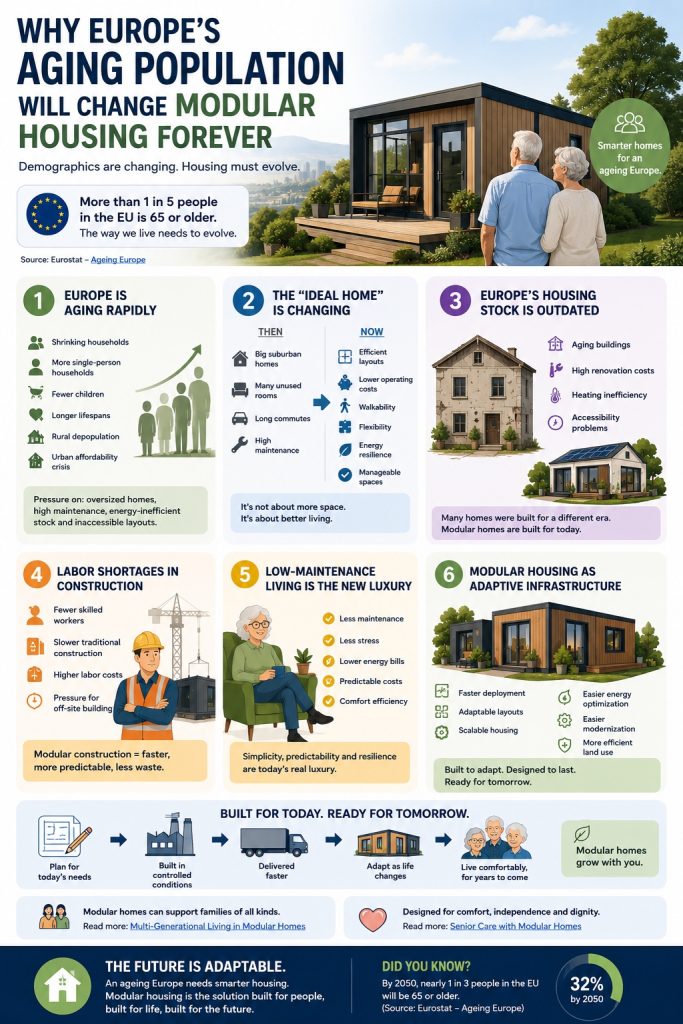
According to Eurostat, more than one-fifth of the EU population is now 65 or older, and that demographic shift is already influencing how people think about housing. You can see the underlying demographic trend in Eurostat’s ageing population data. Traditional homes were designed for a different era, but modular housing can be built for ageing in place, easier upkeep, and faster delivery.
Why Europe’s aging population will change modular housing across Europe
Europe is getting older, and that has real consequences for housing. Longer lifespans, lower birth rates, and more single-person households are changing what people need from a home. At the same time, many rural areas are losing residents while cities remain too expensive for younger buyers.
This creates a mismatch between the housing people already have and the housing they actually need. Large homes with stairs, extra rooms, and high running costs are becoming less practical for many households. Modular housing fits this new reality because it can be designed around compact living, accessibility, and lower operational costs.
Why the old housing model is breaking
For decades, the “ideal home” in much of Europe meant space, ownership, and permanence. But that idea is losing appeal when a large property becomes expensive to heat, difficult to maintain, and hard to adapt. Many buyers now want homes that are easier to manage and more flexible as life changes.
This is especially true for older adults. A home that is too large or too difficult to move through can quickly become a burden rather than an asset. Modular homes in Europe offer a more practical model: a smaller footprint, smarter layout, and features that support comfort without unnecessary complexity.
Europe’s housing stock needs an update
A lot of Europe’s existing housing was built decades ago, when family sizes were larger, and energy costs were different. Many of those homes are now outdated in terms of insulation, layout, and accessibility. Retrofitting them can be expensive, disruptive, and in some cases unrealistic.
That is one reason modular housing is becoming more relevant. Factory-built homes can be designed to meet modern energy standards from the start, instead of requiring major renovation later. They also give developers and homeowners more control over layout, performance, and long-term maintenance.
Construction is facing its own shortage
Europe’s construction sector is dealing with a labour and skills shortage, which makes traditional building slower and more expensive. Fewer workers, rising costs, and delays on site all make conventional construction harder to scale. This is a major reason off-site modular housing is gaining attention.
Because modular homes are built in controlled factory conditions, more of the process is standardized and less dependent on weather or scattered site labour. That means faster delivery, more predictable quality, and less waste. In a market that needs more homes, that efficiency matters.
Low-maintenance living is the new luxury
What used to be seen as downsizing now looks more like a premium lifestyle choice. A home that is easier to maintain, cheaper to heat, and simpler to live in has real value, especially when costs and repairs are unpredictable. In that sense, low-maintenance living is becoming a new version of luxury.
Modern modular homes fit that shift well because they prioritize function without giving up comfort. Instead of paying for extra square metres you do not need, you can invest in better insulation, better planning, and better day-to-day usability. For many buyers, that is more appealing than a large house with hidden upkeep.
Modular housing as adaptive infrastructure
The biggest strength of modular housing is flexibility. It can be designed for single-level living, wider circulation spaces, step-free access, and future mobility needs without the same level of disruption as a traditional retrofit. That makes it especially useful for ageing populations and multigenerational households.
It also works well as a scalable system. A home can start as a compact residence and later expand with an additional module for a caregiver, a family member, or extra support space. That is why modular homes in Europe are increasingly less about “alternative construction” and more about adaptable housing infrastructure.
For a related example of how modular homes can support changing family needs, see our internal article on multi-generational living in modular homes. For another external reference on senior-friendly design, the Flexible Housing for Seniors page is a useful example of how adaptability is being applied in real projects.
The road ahead
Europe’s aging population will change modular housing in ways that go far beyond short-term market trends. As demographic shifts continue to reshape household sizes, accessibility needs, and long-term housing expectations, modular housing is becoming an increasingly important part of Europe’s residential future.
The homes that will stand out in the years ahead are those designed for efficiency, adaptability, and long-term comfort. Modular homes in Europe align naturally with these changing demands by combining faster construction, stronger energy performance, improved accessibility, and easier day-to-day living. In an aging Europe, that level of flexibility and resilience is becoming more valuable than ever.
Frequently asked questions
- Is modular housing only suitable for senior living?
No. Modular housing is suitable for many life stages, but it is especially useful for ageing in place because it can be designed with step-free access, wide doorways, and flexible layouts from the start. - Do modular homes appreciate like traditional houses?
When they are permanently installed, properly permitted, and attached to land, modular homes in Europe can function as real property and benefit from local land value, just like other homes. - Can modular construction help with labour shortages?
Yes. It does not replace workers, but it can make the building process more efficient by shifting much of the work into factory production. - How does downsizing affect well-being? For many people, a smaller and easier-to-manage home reduces stress, cuts maintenance, and creates more room for independence and daily comfort.