Regional Modular Factories in Europe: Local Production and Faster Delivery
Table of Contents
If modular housing is going to scale across the continent, it cannot only be about what happens inside the factory. It also has to be about where that factory is, how far the modules need to travel, and how smoothly production connects with delivery, permits, and installation. That is why regional modular factories in Europe are becoming such an interesting idea right now.
For a long time, the modular conversation has focused on the obvious advantages: faster build times, better quality control, less waste, and more predictable construction. Those benefits still matter. But as the European housing market becomes more complex, buyers are paying more attention to the full delivery system behind a home, not just the final product.
That is where regional production starts to stand out. A more distributed network of modular factories across Europe could help bring manufacturing closer to customers, reduce transport friction, and make projects feel more realistic from day one. In a market shaped by housing shortages, rising expectations, and pressure for faster delivery, that is a meaningful shift.
Why This Topic Matters Now
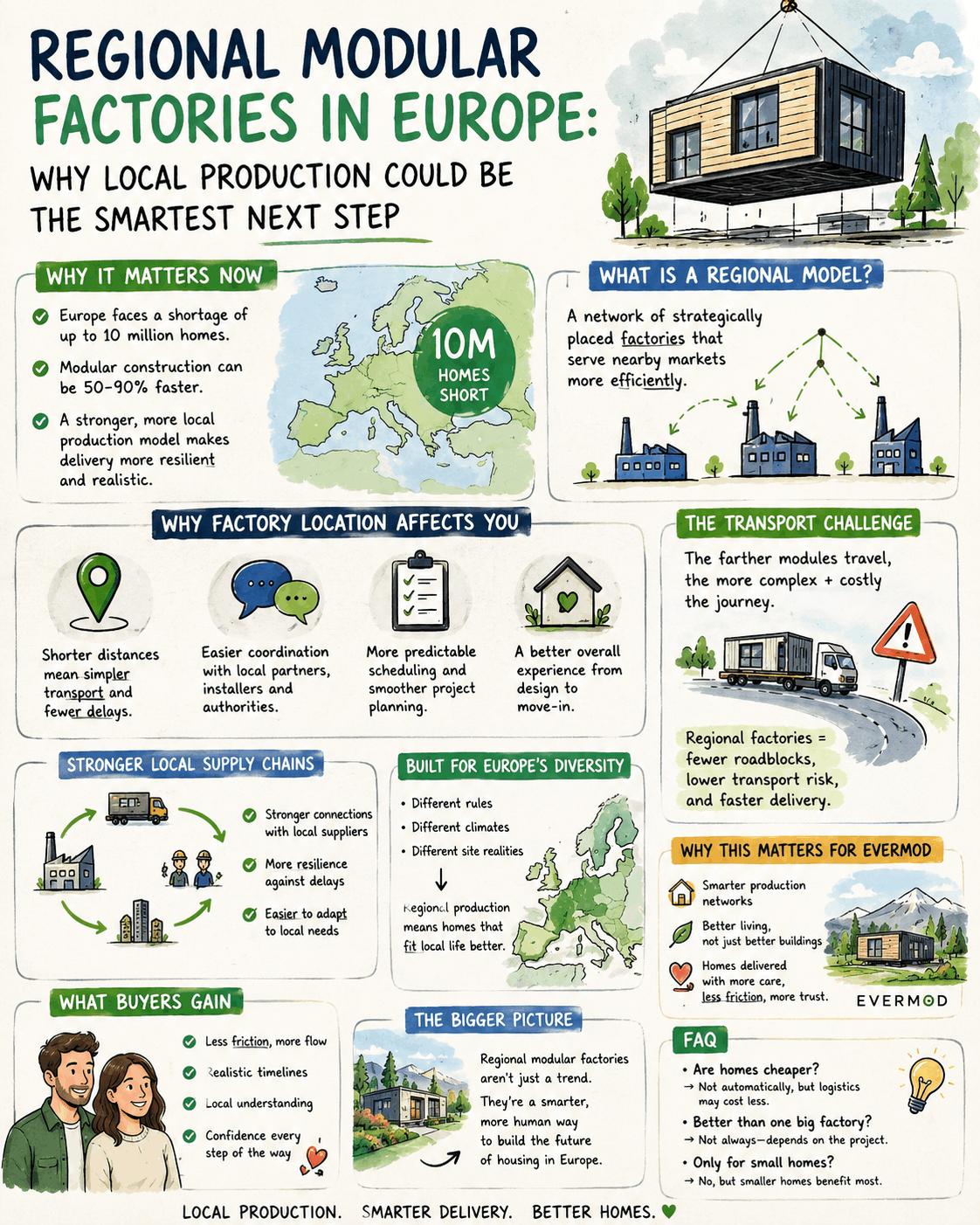
Europe is still under serious housing pressure. The EU faces a shortfall of up to 10 million housing units, roughly 3.5 percent of total stock, while Germany needs 400,000 new homes a year and France has 2.8 million households on social housing waiting lists. Modular construction is gaining more political and industrial attention as one way to accelerate delivery and reduce waste. Recent modular projects have already established a track record of accelerating project timelines by 20 to 50 percent, largely because site preparation and factory production happen at the same time. See Euronews on Europe’s housing shortage and modular construction and McKinsey’s research on modular construction for a closer look at the numbers.
That alone makes modular housing relevant. But the next layer of the conversation is even more useful for buyers: how can modular systems themselves become more resilient, local, and easier to coordinate? The answer may be a stronger regional manufacturing model.
What Regional Modular Factories in Europe Actually Mean
The idea of regional modular factories in Europe does not mean every company needs a factory in every country. It means production can be organized through a smarter network of strategically placed hubs that serve nearby markets more efficiently.
That matters because Europe is not one single building environment. Regulations, planning timelines, transport routes, climate conditions, and site realities vary enormously from one region to another. A more regional factory model can respond better to those differences than a system built around a few distant centralized plants.
In practical terms, regional factories can help shorten delivery distances, improve coordination with local partners, and make it easier to adapt homes to local standards. That does not magically solve every housing problem, but it can reduce friction across the parts of the process that often create delays.
Why Factory Location Affects the Buyer Experience
Most buyers do not spend much time thinking about factory geography at first. They think about design, price, energy efficiency, and how soon they can move in. But factory location influences all of those expectations more than many people realize.
A modular home is not simply built and dropped onto a site. There is a chain behind it: design approvals, production slots, route planning, transport permits, crane access, site preparation, utility connections, and final installation. When the factory is closer to the build site, there is often less room for logistical complications to pile up.
That can mean easier communication, more realistic scheduling, and fewer long-distance transport headaches. In other words, this kind of production model shapes how smooth or stressful the buyer journey feels, not just how fast a module leaves the factory floor.
The Transport Problem Nobody Talks About Enough
One of modular housing’s biggest advantages is speed, but transport can quietly chip away at that advantage if the system is stretched across long distances. The farther a completed module has to travel, the more vulnerable the project becomes to route restrictions, scheduling conflicts, delivery costs, and border complications.
This is one reason a regional production model makes so much sense in Europe. A factory that serves a closer geographic area may be able to simplify transport planning and reduce delays tied to long-haul logistics. It can also make coordination with installers and local contractors more direct.
This part of the process is rarely the most glamorous, but it matters. Buyers may never see the route planning spreadsheet or the transport permit paperwork, yet those details can have a real impact on timelines and confidence — something Evermod deals with directly, shipping from its factory in Latvia to customers across the continent.
Local Supply Chains Make Modular Systems Stronger
A second major advantage of regional production is supply chain resilience. Construction across Europe has become more aware of how fragile long and fragmented supply chains can be. Delays in materials, labour gaps, or a bottleneck in one location can ripple through an entire project.
Regional production can help reduce some of that exposure by building stronger connections between factories, transport providers, installers, and local service partners. The closer those relationships are to the end market, the easier it can be to respond when something changes.
This is also part of a broader shift inside modular construction. Industry organizations such as MBI Europe point to a growing and increasingly organized modular ecosystem across the continent, with member companies spanning multiple European countries and a market that continues to mature. That does not prove every regional model will succeed, but it does show that the infrastructure behind modular housing is becoming broader and more capable.
Why This Fits Europe Better Than a One-Size-Fits-All Model
Europe rewards local understanding. A home that works perfectly in one market may need meaningful adjustments in another because of climate, municipal planning rules, transport access, or utility expectations. That is why a distributed production model can be more realistic than one giant centralized approach.
With regional modular factories in Europe, the goal is not simply to manufacture faster. It is to build a delivery system that is closer to local reality. That could mean better alignment with installers, more familiarity with regional compliance needs, and a smoother handoff from production to site work.
This is especially relevant in modular housing, where timing is one of the biggest selling points. Speed sounds attractive in theory, but buyers only experience it as valuable when the whole process actually works. Regional production helps support that outcome.
Why This Matters for Evermod
For Evermod, this topic is not just an industry trend to comment on — it is close to home, literally. Evermod is based in Latvia and ships modular homes across Europe, with a strong footprint in the Netherlands, Portugal, Spain, Italy, Sweden, Finland, and Iceland. That geographic spread means questions about transport friction, delivery timelines, and local coordination are not abstract for Evermod; they shape how every project actually gets planned and delivered.
Serving markets as varied as southern Europe and the Nordics from a single base in the Baltics means thinking constantly about route planning, climate differences, and local compliance — the exact issues a regional production mindset is meant to solve. It is also part of why the conversation about regional modular factories in Europe matters beyond theory: companies already shipping across this many borders are the ones who feel the transport and coordination challenges first.
That connects naturally with Evermod’s broader content about housing and better living. In How Modular Construction Is Solving Europe’s Housing Crisis One Unit at a Time, the focus is on why modular construction matters at a system level. This new angle adds another layer: if modular is part of the answer, the industry also needs smarter production networks to make delivery more practical.
There is also a natural connection to lifestyle and scale. In The Psychology of Living Small: Why Less Space Makes Us Happier, Evermod explores why smaller homes can feel calmer, more intentional, and more aligned with the way people want to live. Those types of homes are often especially well suited to modular delivery because they are easier to manufacture, move, place, and connect on site.
Together, those ideas create a compelling Evermod message: better housing is not only about architecture or square metres. It is also about making the path from design to delivery simpler, faster, and more human.
What Buyers Should Take From This
For buyers, regional modular factories in Europe matter because they suggest a future with less friction. That does not mean every project will suddenly become effortless. Permits, site work, financing, and utilities will still matter. But a more regional production model can make the entire modular process more grounded in local conditions and easier to coordinate.
That is important because confidence is a big part of the buying decision. People want a beautiful home, but they also want a process that feels believable. They want timelines that sound realistic, logistics that make sense, and a company that understands what it takes to deliver in the real world.
In that context, regional factories are not just a manufacturing trend. They are part of a more mature version of modular housing in Europe, one built around trust as much as speed.
FAQ About Regional Modular Factories in Europe
What are regional modular factories in Europe?
Regional modular factories in Europe are production hubs located closer to the markets they serve, rather than relying only on a few large centralized factories. The idea is to improve delivery efficiency, strengthen local coordination, and reduce some of the transport and supply chain friction that can slow down modular home projects.
Why do regional modular factories matter for buyers?
They matter because factory location can affect delivery time, transport complexity, coordination with local partners, and how predictable the overall process feels. For buyers, that can translate into a smoother project experience and more confidence in the timeline.
Do regional modular factories make homes cheaper?
Not automatically. Pricing still depends on design, materials, site conditions, transport needs, permits, and installation. But regional production may help control some costs related to logistics and long-distance delivery.
Are regional modular factories better than one large factory?
Not in every case. Large factories can still be efficient and important. The regional model is attractive because Europe is highly fragmented, with different rules, climates, and logistics in each market, so local or regional production can sometimes be more practical.
How do regional factories support the housing market in Europe?
They can help modular housing scale more effectively by reducing delivery friction and making production networks more adaptable. In a market facing housing shortages and pressure for faster delivery, that makes regional production a useful part of the bigger picture.
Is this relevant only for small modular homes?
No, but smaller homes often fit this model especially well because they are easier to produce, move, and install. That said, the same logic can apply to larger modular homes and multi-unit projects depending on the location and factory setup.