How Much Land Do You Actually Need for a Modular Home?

Table of Contents
It’s one of the first questions future homeowners ask, and it sounds deceptively simple: how much land do I need for a modular home? Some websites say 300 m² is plenty. Others recommend 1,000 m² or more. The honest answer is that both can be right, depending on who’s asking.
The ideal modular home plot size isn’t a fixed number. It depends on your lifestyle, your chosen home, local planning rules, and how you plan to use the space around you. The encouraging news is that modular homes are genuinely flexible, far more so than many traditional builds, which gives you real freedom when it comes to choosing where to live.
This guide walks you through what actually determines the right amount of land, why bigger isn’t always better, and how to find a plot that works for both your home and your life.
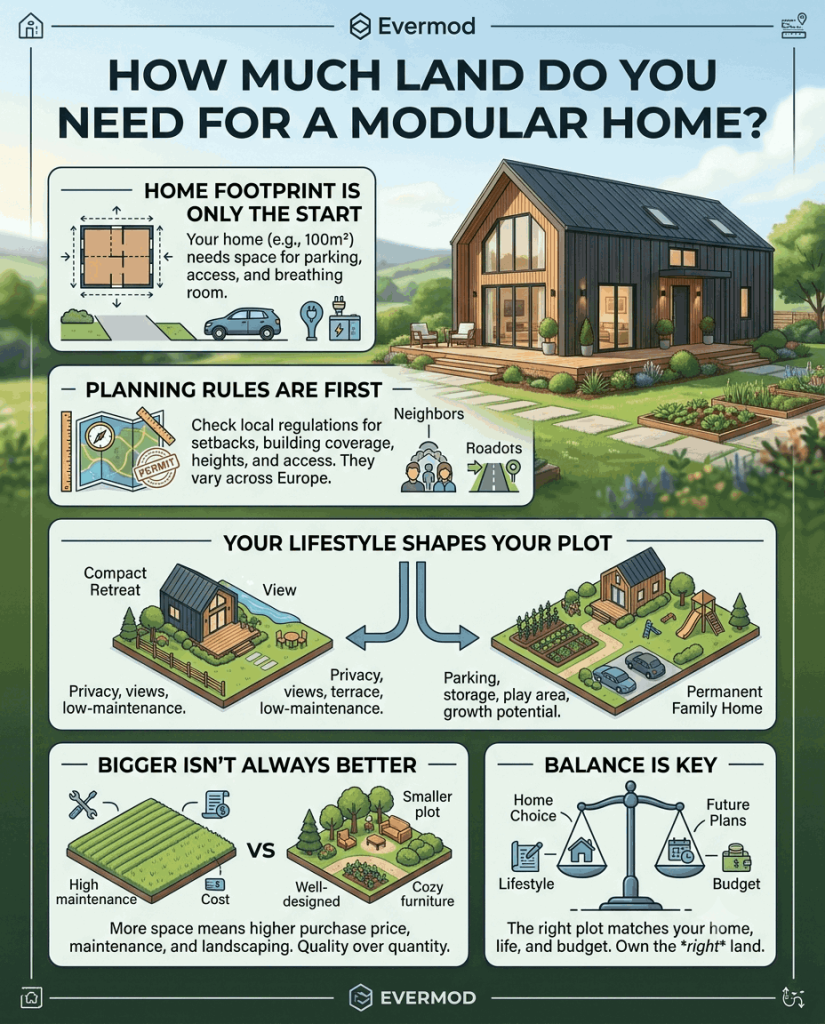
The Home Is Only Part of the Picture
Many first-time buyers focus almost entirely on the size of the house itself, which is understandable but slightly misleading. Imagine your Evermod home has a footprint of around 80–100 m². A 120 m² plot might seem sufficient on paper, but in practice, a comfortable property needs considerably more breathing room.
Before settling on a plot size, think carefully about what you’ll need around the building itself. Parking and access matter more than people expect — even one or two extra parking spaces make a meaningful difference when family visits or deliveries arrive.
Speaking of deliveries, Evermod homes are built off-site and delivered in sections, which means your plot needs reasonable access for vehicles and, in some cases, crane equipment. This rarely requires a wide highway; often a temporary adjustment like removing a fence or trimming vegetation is all that’s needed. If you’re unsure whether your land qualifies, our guide Can You Really Build a Modular Home Anywhere? (Europe Edition) covers accessibility and installation in detail.
Beyond parking and access, you’ll also want to leave space for outdoor seating, utility connections, drainage, and simply being able to move comfortably around your own property. These practical considerations often have a bigger impact on daily life than the total square metres shown on a land listing.
Local Planning Rules Come First
Before you fall in love with a particular plot, it’s worth understanding what local planning regulations actually allow — they directly influence how much land you can build on and what you can do with the rest. Across Europe, municipalities set their own rules around minimum distances from roads and neighbouring properties, maximum building coverage, permitted heights, and access requirements. These rules can vary significantly not just between countries but between neighbouring towns.
The European Commission provides guidance on spatial planning and sustainable land management through its Land Use and Soil initiatives, reflecting just how seriously responsible land development is taken across the continent. Modular homes like those from Evermod follow the same planning regulations as conventional residential buildings, so the rules that apply to a traditional home apply here too — and checking them before you buy can save a great deal of time and money later.
Your Lifestyle Shapes Your Plot More Than Anything Else
Here’s something that surprises many buyers: two people could choose the exact same Evermod model and need completely different plots. That’s because the home itself is only one piece of the equation.
If you’re building a holiday retreat, your priorities might be beautiful views, a terrace for evening meals, privacy, and low maintenance. A well-positioned, compact plot can deliver all of that with room to spare. For a permanent family residence, the picture changes considerably; you’ll likely want dedicated parking, outdoor storage, space for children to play safely, and perhaps a vegetable garden. And if you’re thinking long term, it’s worth considering whether you’d eventually like to add a sauna, a pergola, a guest unit, or a small workshop. Planning for those possibilities early is far cheaper than trying to retrofit them onto a cramped plot later.
Rather than asking how much land you need in square metres, a more useful question is: what kind of life do I want to live here, and what space does that actually require?
Bigger Isn’t Always Better, and Often Costs More
It’s tempting to assume that buying the largest plot you can afford is the safest bet. In reality, oversized land often creates problems that buyers don’t anticipate. Larger plots come with higher purchase prices, more landscaping work, increased ongoing maintenance, additional fencing, and more time spent simply keeping things tidy. That’s before considering the environmental dimension; the European Environment Agency has highlighted the importance of sustainable land use to reduce unnecessary land consumption and protect natural ecosystems, and this thinking increasingly shapes planning policy across Europe.
A well-chosen plot that genuinely fits your lifestyle will almost always feel more satisfying than one that’s technically larger but poorly suited to how you actually live. Knowing how much land you actually need, rather than how much you can afford, is often what separates a satisfying purchase from a costly one.
Privacy is a good example. A thoughtfully positioned 500 m² plot with natural tree cover, a gentle slope, or good hedging can feel far more spacious and peaceful than an exposed 1,500 m² field. When you visit potential plots, try to imagine how you’ll actually spend your time there rather than simply comparing numbers on a listing.
Should You Choose the Home or the Land First?
This is a question we hear regularly, and the answer might surprise you: starting with the home usually leads to a smoother experience. Once you have a clear sense of which Evermod model fits your vision – whether that’s a compact design for a quieter lifestyle or a larger family home – it becomes much easier to identify land that genuinely suits the project. You’ll know what footprint you’re working with, what access you’ll need for delivery, and what outdoor space would feel right. That clarity makes the land search far less overwhelming.
If you’re still weighing up whether now is the right moment to buy land at all, our guide Is 2026 the Right Time to Buy Land in Europe? explores the current market across Europe. And if budget is a significant factor, it’s worth remembering that the cheapest plot isn’t always the most economical choice — a slightly more expensive property with road access and nearby utilities can save thousands during development. We’ve looked at this in detail in our guide to the cheapest countries in Europe to buy land for a modular home.
Finding the Right Balance
So, how much land do you need for a modular home? For most people, the answer isn’t a specific number of square metres, it’s a balance between your chosen home, your lifestyle, local planning requirements, the outdoor space that matters to you, your plans for the future, and your budget.
A plot that fits your life well will always feel better to live on than one that simply looks impressive on paper. The goal isn’t to own more land. It’s to own the right land.
If you’re ready to start thinking about your project, explore the full range of Evermod’s turn-key modular homes and see which designs feel right for the life you’re planning. Knowing your home is often the clearest way to find the land that belongs with it.
Frequently Asked Questions
How much land do I need for a modular home?
There is no single answer. The right modular home plot size depends on your home’s footprint, local planning regulations, how you plan to use outdoor space, parking needs, and your long-term plans. A well-matched plot will always serve you better than simply the largest one available.
What is the minimum land size for a house?
This varies between countries and municipalities. Local planning authorities set their own requirements covering setbacks, building coverage, and access. Always check local regulations before purchasing land, as rules can differ even between neighbouring towns.
Can modular homes be built on smaller plots?
Yes, this is one of the genuine advantages of modular construction. Many Evermod homes are well suited to compact residential plots, provided local planning regulations and delivery access requirements are met.
Can Evermod help me work out if my land is suitable?
Absolutely. Our team can evaluate your plot, discuss delivery access, recommend suitable foundation options, and advise which Evermod model best matches your land and your vision. Get in touch and we’ll be happy to help.
For further reading on sustainable land use and planning across Europe, the FAO Voluntary Guidelines on the Responsible Governance of Land Tenure offer a comprehensive overview of land rights and responsible land management.