AI Home Design: How Artificial Intelligence Will Shape Future Homes in Europe

Table of Contents
Artificial intelligence is already transforming how people work, shop, travel, and communicate. The next major frontier may be where we live. While most conversations around AI focus on chatbots, automation, and productivity tools, a quieter revolution is beginning to emerge in architecture, construction, and residential design.
AI home design has the potential to fundamentally change how homes are planned, customized, and built across Europe. Rather than creating houses based on broad assumptions about how people live, future design systems may use data, behavioral insights, environmental conditions, and lifestyle preferences to create homes tailored to individual needs.
For homeowners, this could mean better layouts, lower energy bills, and spaces that adapt to changing lifestyles. For the construction industry, it may represent one of the biggest shifts since the introduction of computer-aided design. As Europe continues to embrace digital innovation and sustainability goals, AI home design is rapidly moving from futuristic concept to practical reality.
What Is AI Home Design?
At its core, AI home design refers to the use of artificial intelligence to assist in planning, optimizing, and personalizing residential spaces.
Traditionally, architects and designers rely on experience, client discussions, and established design principles when creating floor plans. While these methods remain essential, AI introduces an entirely new layer of analysis. By processing large amounts of information, AI systems can evaluate how people use space, predict future needs, and suggest layouts that maximize comfort, functionality, and efficiency.
Instead of asking homeowners to choose between a handful of predefined floor plans, AI could generate thousands of potential configurations based on specific preferences. A remote worker may receive recommendations that prioritize office space and natural lighting, while a family with young children may see layouts optimized for safety, storage, and flexibility.
The goal is not to replace human creativity but to enhance it through data-driven insights that were previously impossible to process at scale.
How AI Home Design Could Personalize Every Home
One of the most exciting aspects of AI home design is the potential for true personalization.
For decades, housing developments have largely followed standardized models. While customization options exist, most buyers are still selecting from a limited set of designs. Artificial intelligence could change that entirely.
Imagine two families purchasing homes of the same size. One household works remotely and values privacy, while the other prioritizes entertaining guests and social interaction. AI could analyze lifestyle preferences and generate entirely different layouts despite identical square footage.
This is where AI modular home design becomes particularly interesting. Modular construction already offers a level of flexibility that traditional building often struggles to match. By combining modular systems with AI-driven customization, future homeowners may be able to create spaces that reflect how they actually live rather than adapting themselves to predefined layouts.
The result is a more human-centered approach to housing, where homes are designed around people instead of people adapting to homes.
Future Homes in Europe Will Be Designed Around Data
The future homes Europe builds may rely heavily on information that goes far beyond simple floor plans.
Artificial intelligence can analyze environmental factors such as sunlight patterns, prevailing winds, seasonal temperatures, and local climate conditions before construction even begins. Rather than relying solely on standard design practices, AI can help determine the optimal placement of windows, living spaces, outdoor areas, and energy systems.
A house built in southern Spain may require different design priorities than one located in Finland or Latvia. AI systems can evaluate these regional differences and recommend solutions that improve comfort while reducing energy consumption.
This aligns closely with Europe’s increasing focus on sustainable development and climate resilience. Organizations such as the World Economic Forum have highlighted how artificial intelligence is becoming a critical tool in creating smarter, more efficient cities and infrastructure.
As digital planning tools become more sophisticated, future housing may become increasingly responsive to local conditions rather than relying on one-size-fits-all solutions.
AI Could Reduce Energy Costs Before Construction Begins
Energy efficiency is already one of the most important considerations for European homeowners. Rising utility costs and stricter sustainability regulations are encouraging buyers to prioritize long-term performance over short-term savings. Artificial intelligence has the potential to make homes more efficient before they are even built.
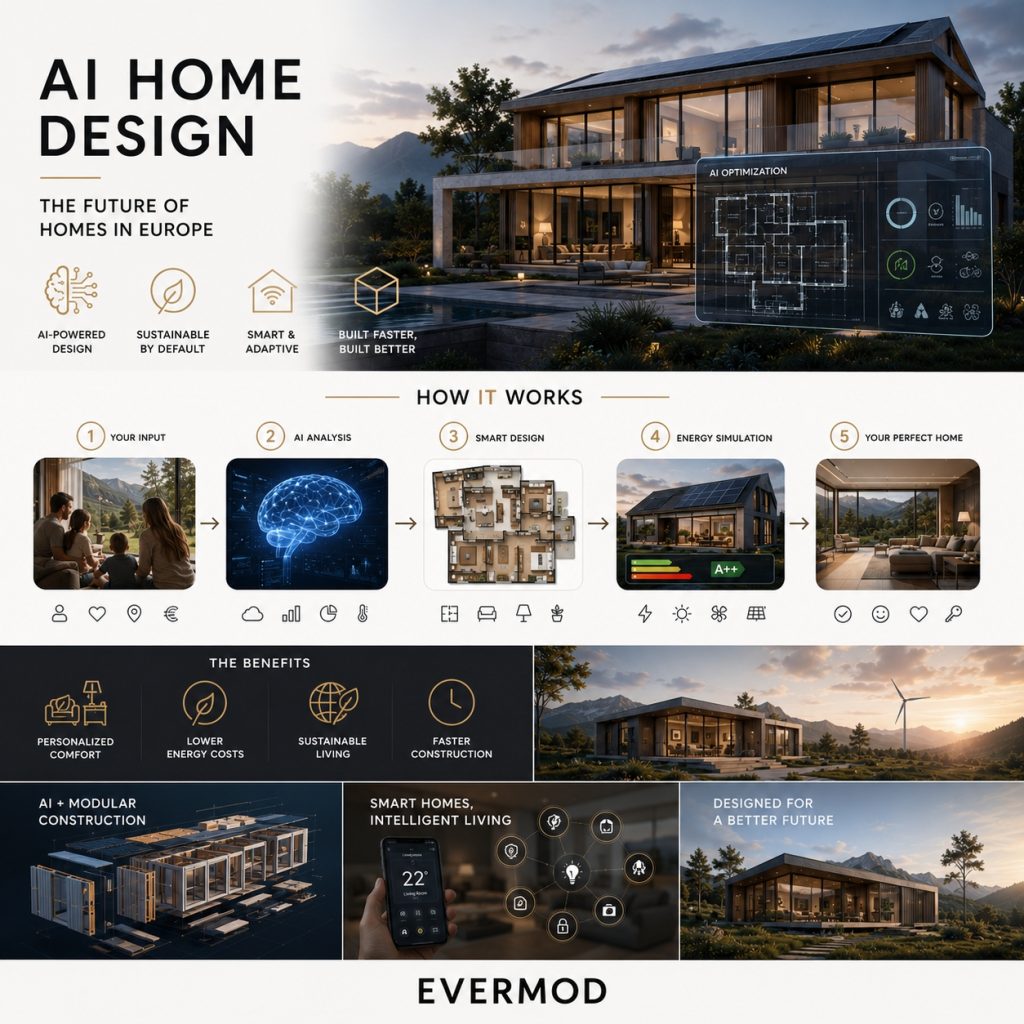
By simulating thousands of design scenarios, AI can identify the most effective combinations of insulation, window placement, roof orientation, ventilation systems, and renewable energy integration. Instead of discovering inefficiencies after construction, homeowners could benefit from optimized performance from day one.
Research from MIT Technology Review has explored how AI is increasingly being applied to architecture, engineering, and building performance optimization. These technologies allow designers to evaluate countless variables that would be difficult or impossible to calculate manually.
For homeowners, the outcome could be lower operating costs, improved comfort, and reduced environmental impact.
The Rise of Smart Home Trends and Predictive Living
Many of today’s smart home technologies already use elements of artificial intelligence, even if homeowners do not always recognize it.
Smart thermostats learn temperature preferences. Automated lighting systems adapt to occupancy patterns. Security systems use machine learning to distinguish between normal activity and potential threats. However, Europe smart home trends are moving toward a much more integrated future.
Rather than individual devices operating independently, future homes may function as interconnected ecosystems. AI could anticipate energy usage, adjust lighting throughout the day, optimize heating and cooling schedules, and even coordinate electric vehicle charging based on electricity prices.
Predictive living may become one of the defining characteristics of future homes. Instead of reacting to homeowner commands, homes may proactively manage resources to improve comfort and efficiency. As these technologies mature, the distinction between architecture and software may continue to blur. We explored this evolution further in our article on smart homes and modular living: the perfect match, where connected technologies are already transforming the way people interact with their homes.
As these technologies mature, the distinction between architecture and software may continue to blur.
Why AI Modular Home Design Could Lead the Next Housing Revolution
Modular construction may be uniquely positioned to benefit from artificial intelligence.
Unlike traditional building methods, modular homes are manufactured within highly controlled environments where precision and repeatability are essential. This creates an ideal foundation for AI-powered optimization.
AI modular home design could allow manufacturers to customize layouts, materials, and energy systems based on individual site conditions and homeowner preferences before production even begins.
A future buyer may simply input information about their family size, lifestyle, location, climate, and budget. AI could then generate multiple optimized modular home configurations tailored specifically to those requirements.
This level of personalization would have been difficult and expensive to achieve using traditional construction methods. With modular systems, however, it becomes far more practical. The combination of artificial intelligence and modular construction could significantly accelerate the shift toward personalized housing.
Why Smart Modular Homes Are a Natural Evolution
The relationship between AI and modular housing is already beginning to emerge. As renewable energy systems become increasingly common, intelligent software will play a larger role in managing energy production, storage, and consumption. This trend complements the ideas discussed in our guide to solar-ready modular homes transforming sustainable living in Europe, where future-focused housing is designed to be both efficient and adaptable.
Likewise, innovations in renewable energy are becoming a central part of residential design. Our guide to solar-ready modular homes transforming sustainable living in Europe explores how energy generation and smart technologies are increasingly working together to create future-ready housing.
Artificial intelligence may ultimately become the system that connects all of these technologies into a single intelligent ecosystem.
Will AI Replace Architects and Designers?
Whenever new technologies emerge, questions about job displacement inevitably follow. In reality, artificial intelligence is unlikely to replace architects anytime soon. Instead, it will probably become another powerful tool within the design process.
Architects bring creativity, emotional understanding, cultural awareness, and human judgment to projects. AI excels at analyzing data, identifying patterns, and evaluating thousands of possibilities quickly.
The most successful professionals will likely be those who combine both strengths. Much like computer-aided design transformed architecture without eliminating architects, artificial intelligence is expected to enhance human expertise rather than replace it. The future of design will probably be collaborative, combining human creativity with machine intelligence.
A More Personalized Future for European Housing
For much of modern history, housing has been designed around averages. Standard floor plans, standard room sizes, and standard assumptions have shaped how homes are built. AI home design points toward a different future.
As artificial intelligence becomes more sophisticated, homes may increasingly reflect the specific needs, habits, and goals of the people who live in them. Energy systems could adapt automatically, layouts could be optimized before construction begins, and modular designs could be customized at an unprecedented level.
The future homes Europe builds may not simply be smarter. They may become more personal, more efficient, and more responsive to the people they serve. For homeowners, builders, and designers alike, the age of AI-assisted housing may be closer than many realize.
AI Home Design FAQ’s
- What is AI home design?
AI home design uses artificial intelligence to help plan, optimize, and personalize residential spaces based on factors such as lifestyle preferences, energy efficiency goals, climate conditions, and spatial requirements.
- How can AI improve home layouts?
AI can analyze how people use space and generate customized floor plans that maximize functionality, comfort, natural light, storage, and energy performance.
- What is AI modular home design?
AI modular home design combines artificial intelligence with modular construction to create highly personalized housing solutions that can be optimized before manufacturing begins.
- Are AI-designed homes already being built?
Elements of AI-assisted design are already being used in architecture, engineering, smart home systems, and construction planning, although widespread adoption is still developing.
- How does AI support energy efficiency?
AI can simulate design scenarios, optimize insulation and window placement, and help integrate renewable energy systems to reduce long-term energy consumption.
- Will AI replace architects?
Most experts believe AI will enhance the work of architects rather than replace them, helping professionals make better decisions while retaining human creativity and judgment.