
Tiny Homes & Parenthood: Smart Storage, Safety, Sanity

Parenthood changes everything from your sleep schedule to your living space. We are talking to the ones who know it and warning the parents to be, haha. For families who choose tiny or modular homes, the arrival of a baby brings a new set of challenges and opportunities. How do you make the most of a smaller footprint while ensuring safety, comfort, and peace of mind?
The good news: modular homes are uniquely positioned to help families thrive during this exciting stage of life. With smart design, adaptability, and the right priorities, tiny modular living can support both your growing family and your sanity.
Why Space Feels Different With a Baby
Before children, many people see compact living as simple, minimalist, and cost-saving. But once a newborn arrives, space takes on new meaning. Suddenly, every corner matters: where do you put the crib, the stroller, the bottles, the toys that multiply in the blink of an eye?
This is where modular design has a huge advantage over conventional small homes. Tiny modular houses are not just “small,” they’re engineered for flexibility and function. Unlike traditional construction, in modular homes, nothing goes to waste; each square meter is thoughtfully planned in a carefully controlled building process.
And with Evermod’s models like the Barn or the larger Barn Max, families can enjoy layouts that balance openness with smart zoning. These homes were built with scalability in mind, perfect for parents who may need more space down the road.
Smart Storage: The Secret Weapon
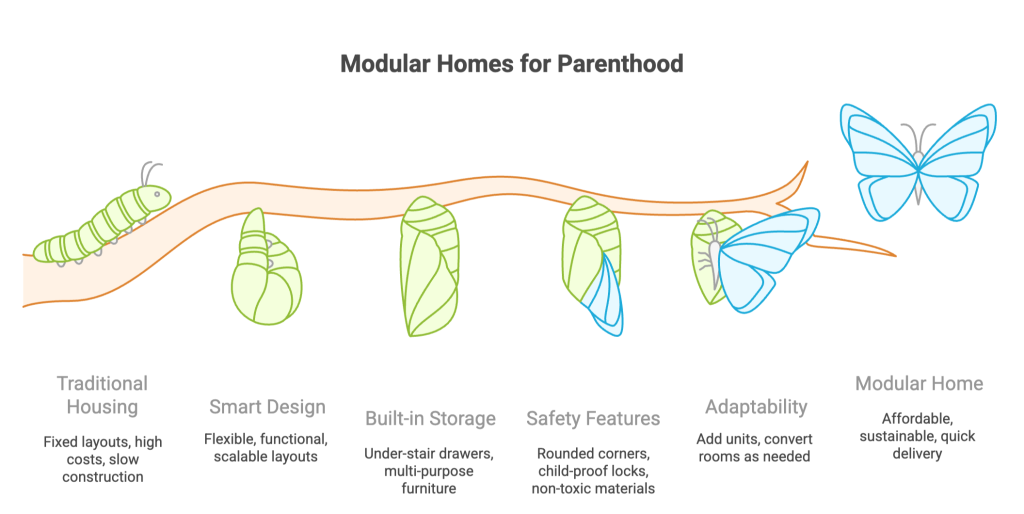
When expecting a baby in a modular home, storage becomes your best friend. Modular designs allow for built-in storage solutions that traditional homes often overlook:
- Under-stair drawers for baby supplies.
- Multi-purpose furniture like a crib that transforms into a toddler bed.
- Hidden shelving within walls or benches.
Instead of adding bulky storage units, these built-in features keep everything streamlined and clutter-free, essential for parents who need quick access to baby gear while keeping the home calm and organized.
External inspiration: Pratt Homes explores how compact layouts can still prioritize function in their article on Tiny Home Design and Expecting a New Baby.
Safety First: Designing With Parenthood in Mind
Babies are curious explorers, and in a smaller home, that curiosity is concentrated. Safety features are essential:
- Rounded corners on furniture to prevent bumps.
- Child-proof locks for kitchen cabinets.
- Non-toxic materials (low-VOC paints, sustainable finishes) to protect sensitive lungs.
Evermod integrates sustainable, health-conscious materials into its units, an important detail for parents who want to raise children in an environment that feels as safe as it looks.
Sanity Through Simplicity
Parents quickly learn that clutter equals stress. Modular homes encourage a minimalist mindset by design. Instead of rooms filled with unnecessary furniture, families are encouraged to prioritize what truly matters. This doesn’t mean sacrificing comfort; rather, it means curating an environment where every item has a purpose. Fewer distractions create calmer spaces, which support mental well-being for both parents and children.
Why Modular Homes Work for Young Families
Parenthood often brings a fresh perspective on what “home” really means. For many new parents, it’s less about square footage and more about functionality, comfort, and security. This is where modular homes shine; they offer unique benefits compared to traditional housing that are especially relevant for families with young children.
Adaptability – Homes That Grow With You
Life with children changes fast. One year, you’re baby-proofing every outlet, and the next, you’re figuring out where to stash bikes and homework projects. Traditional houses often lock families into fixed layouts, but modular homes are built for adaptability.
Need an extra bedroom when baby number two arrives? Many modular designs allow for additional units to be added without major disruptions. A home office can be converted into a nursery or vice versa as kids get older.
Take Evermod’s Barn Max, for example. Its open layout and scalable design mean families can start small and expand as needs shift, ensuring the home grows with your family instead of against it.
Affordability: Freeing Up Your Budget for What Matters Most
Parenthood also brings new financial priorities, childcare, education, healthcare, and of course, the never-ending supply of snacks. Traditional housing markets across Europe often put families under immense financial pressure. Modular homes, however, provide a cost-effective alternative without sacrificing quality.
Because modular units are built in controlled environments, there’s less waste, fewer delays, and significantly lower construction costs. That translates into lower purchase prices and reduced maintenance expenses over time.
The savings don’t just stay on paper; they go directly into things families actually care about: quality daycare, family vacations, or simply building a financial safety net for the future. By choosing a modular home, parents can prioritize raising their children instead of servicing a massive mortgage.
Sustainability Means a Healthier Home for Children
Parents are often the most eco-conscious homeowners, after all, the decisions you make today affect your children’s tomorrow. Modular homes are designed with sustainability in mind, and that has direct health and well-being benefits for families.
Energy-efficient insulation means homes stay warmer in winter and cooler in summer, reducing utility costs while keeping babies and toddlers comfortable. Low-VOC paints and sustainable materials reduce indoor pollutants, creating a healthier environment for sensitive lungs and immune systems.
For families who dream of raising their kids closer to nature, modular living also offers the chance to integrate with the countryside in a way that’s gentle on the planet. Evermod’s Barn unit, for instance, combines modern energy standards with timeless design, ideal for parents who want eco-friendly living without compromise.
Speed of Delivery Matters, Because Parenthood Doesn’t Wait
One of the most overlooked benefits of modular homes is how fast they can be built and delivered. Traditional construction can take years, with delays caused by weather, labor shortages, and supply chain issues. For expectant parents or young families, that simply isn’t practical.
Modular homes, however, are prefabricated in factories and assembled on-site in a fraction of the time. This means families can move into their new home within months—not years.
For parents balancing pregnancy timelines, work schedules, and childcare needs, this speed offers peace of mind. Imagine moving into a safe, fully functional home before the baby arrives, without the chaos of endless renovations or half-finished projects. With modular construction, that’s entirely possible.
Avoiding Common Mistakes
As Pratt Homes points out in their blog, families often fall into pitfalls like underestimating space needs, overlooking storage, or failing to plan for expansion. Choosing the right modular partner ensures your home is future-proof, not just baby-proof.
At Evermod, every design takes growth, adaptability, and sustainability into account, so families can invest in a space that will serve them for decades, not just during the newborn phase.
Final Thoughts
Parenthood changes everything, but it doesn’t have to mean giving up the dream of living simply, sustainably, and beautifully. With smart design, tiny modular homes can support families through the baby years and beyond.
At Evermod, we help parents create spaces that nurture both children and peace of mind. Because whether your home is 40 m² or 140 m², what matters most is how it grows with you.