
Modular Housing in Europe Today: What 2026 Buyers Need to Know

Europe’s housing market is changing rapidly, and modular construction is no longer an alternative; it is becoming a core solution for affordability, sustainability, and fast delivery. If you’re considering a modular home in 2026, understanding today’s trends can help you make smarter decisions. This guide breaks down the latest modular housing news in Europe, the technologies shaping the industry, and the policies that are pushing modular living forward.
Whether you’re researching prices, sustainability, or future-proof housing, this overview gives you a clear picture of where modular is heading and why the shift matters.
Why Modular Housing Is in the News Today in Europe
Searches for modular housing news today in Europe and discussions around prefab housing news in Europe have surged because the continent is trying to solve three major issues at once: housing shortages, energy regulations, and rising construction costs. Countries across the EU are accelerating the adoption of off-site building methods because they are cleaner, faster, and more predictable than traditional construction.
Recent updates from the European Environment Agency highlight the need for low-emission building practices as part of Europe’s long-term sustainability commitments. We know, we have been speaking about it A LOT. These goals directly influence how modular homes are designed, insulated, and manufactured today.
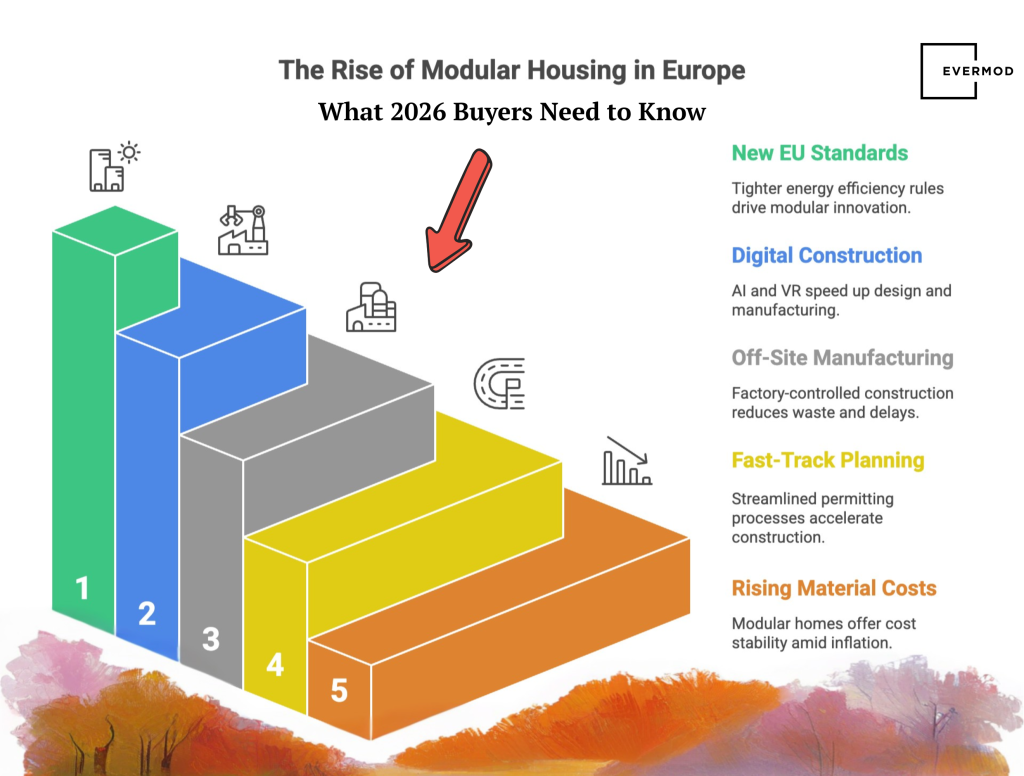
New EU Building Standards Are Driving Modular Innovation
As of 2025, tighter rules under the EU Energy Performance of Buildings Directive (EPBD) are pushing for higher energy efficiency across all new buildings, encouraging the use of low-emission materials and promoting the widespread adoption of nearly zero-energy buildings (nZEB).
These changes make modular construction more attractive because factory-built homes naturally achieve better energy performance. Precision manufacturing means better air sealing, better insulation, and fewer on-site errors.
For readers who want to explore energy requirements deeper, the updated legislation can be reviewed directly through the EU EPBD resource.
These standards are also shaping the latest Evermod designs, which already follow nZEB principles and modern insulation approaches. To learn how insulation impacts overall home health and performance, you can read the Evermod guide about the importance of insulation in modular homes.
Digital Construction & AI Are Speeding Up European Builds
Among the biggest news trends in modular and prefab housing is the rise of digital engineering tools such as AI-driven design optimization, VR home previews, BIM-based cost forecasting, and automated factory systems. These technologies are reshaping how modular homes are designed, priced, and manufactured, making the entire process faster, more accurate, and more accessible for future buyers.
In countries like Germany, Denmark, and the Netherlands, AI is already being used to reduce design time and optimize energy performance before a single wall is produced. This makes modular builds not only more accurate but also more affordable, a major benefit for 2026 buyers.
Off-Site Manufacturing Is Expanding Across Europe
“Off-site manufacturing expansion” is one of the most impactful trends appearing in modular housing news in Europe today.
This shift matters because factory-controlled construction can reduce material waste by up to 80%, while eliminating weather-related delays that often slow traditional building projects. It also ensures that homes are produced in protected, highly regulated environments where quality remains consistent from start to finish. As a result, construction timelines become far more predictable, even in periods of labor shortages.
Northern Europe has led this shift for years, but Southern Europe is now rapidly catching up due to rising demand for energy-efficient, ready-to-live homes.
For example, Evermod’s turn-key modular units highlight how off-site construction allows buyers to receive a fully finished home installed in days, not months. You can always explore how turn-key modular home technology worksmore deeply to really educate yourself about the topic.
Fast-Track Planning Is Becoming More Common
Another key trend worth integrating into this topic is the accelerated planning process for modular buildings. Several EU countries are now testing streamlined permitting systems that apply to prefab homes, modular apartment blocks, temporary housing units, and even disaster-relief or workforce accommodations. This faster approval structure aims to reduce the long administrative delays that traditionally slow down construction projects across Europe.
This is appearing more frequently in news reports because local governments are looking for ways to solve the housing crisis without sacrificing quality or environmental standards. So if you’re planning to build in 2026, choosing modular may offer faster approvals depending on your country or region.
Rising Material Costs Are Changing Buyer Behavior
One of the biggest reasons people are searching for modular and prefab housing updates today is the rise in raw material costs across Europe. Concrete, steel, and labor shortages have significantly increased the price of traditional building.
Modular homes help reduce these rising costs in several ways. Manufacturers can bulk-purchase materials at stable prices, significantly lowering expenses. Waste is minimized through controlled factory production, and reliance on large on-site labor teams is reduced thanks to automated and streamlined processes. While modular construction is not immune to inflation, controlled factory production provides greater price stability, something many buyers will value in 2026.
What All This Means for 2026 Modular Home Buyers
Today’s news surrounding modular construction in Europe is more than headlines; it directly affects your future home purchase. Here’s how:
- Better energy performance → lower bills, fewer upgrades
- More design precision → fewer repairs and long-term issues
- Faster building timelines → predictable move-in dates
- Emerging regulations → more high-quality, eco-conscious homes
- Growing industry investment → more factory capacity and lower costs
Modular living is becoming mainstream because it aligns with Europe’s environmental goals, urban planning challenges, and the growing demand for affordable, flexible living solutions.
Final Thoughts on 2026 Modular Trends
If you’re following modular housing news in Europe or keeping an eye on prefab housing news in Europe, you’re witnessing one of the strongest housing shifts in decades. With new EU rules, digital tools, sustainability requirements, and massive off-site factory expansion, the modular industry is positioned to dominate the European housing landscape by 2026.
Whether you’re considering a compact modular home, a turn-key unit, or simply exploring future housing options, understanding these trends helps you make informed decisions today, tomorrow, and the years to come.