Modular Hotels in Europe: How Turn-Key Units Will Reshape Hospitality in 2026
Europe’s hospitality sector is entering a new phase. Travel demand is less predictable, construction costs remain high, skilled labor is harder to secure, and tourism is increasingly shaped by short-term peaks rather than steady year-round flows. You know, everyone follows the Instagram trends.
In this environment, traditional hotel development models often struggle to keep up. Modular hotels are emerging not as a design trend, but as an operational solution that aligns with how hospitality actually functions in 2026. From fast-deployment hotels near major events to compact urban infill projects and scalable resort concepts, modular construction is reshaping how hotels are planned, built, and operated across Europe.
Scaling Hotel Capacity Quickly Without Long Construction Delays
One of the biggest challenges facing hotel developers today is time. Traditional hotel construction is linear: groundwork, structure, interiors, and finishing all happen sequentially, often stretching timelines to two or three years. In fast-moving tourism markets, this delay can mean missing the most profitable window entirely. Modular hotels work differently. Hotel units are manufactured off-site while foundation and site preparation happen in parallel. Rooms arrive fully assembled or as large volumetric modules, ready to be installed and connected.
In practice, “ready-to-install” means that interiors, bathrooms, wiring, insulation, and finishes are already completed before delivery. This approach allows modular hotels to open in months rather than years. For operators and investors, predictable timelines reduce financing risk and make it easier to plan openings around specific seasons, contracts, or events. In markets where speed directly affects revenue, fast-deployment hotels are becoming a strategic advantage.
Pop-Up and Seasonal Modular Hotels Across Europe
Tourism in Europe is highly seasonal. Coastal destinations, alpine regions, rural retreats, and nature-based travel hubs often experience intense demand during short periods, followed by quieter months. Permanent hotel structures are not always the most efficient response to this pattern. Modular accommodation in Europe enables pop-up and seasonal hotel concepts that can expand, contract, or relocate depending on demand.
Modular hotel units can be installed for peak seasons, extended for multiple years, or repurposed for new locations as tourism patterns evolve. This flexibility supports summer-only destinations, winter resorts, and remote nature locations where permanent construction may not be viable. Instead of committing to oversized, underutilized buildings, operators can scale capacity gradually and adjust layouts as performance data becomes available.
Event-Driven Tourism Is Accelerating Modular Hotel Demand
Large-scale events are increasingly shaping travel flows across Europe. International expos, major sports tournaments, cultural festivals, and rotating global events create sudden spikes in accommodation demand that traditional hotel development cannot match. Modular hotels in Europe are particularly well-suited to event-driven tourism. Modular hotel design enables developers to deliver high-quality accommodations quickly, without creating long-term oversupply once the event concludes.
Afterward, units can be relocated, converted to other uses, or integrated into longer-term hospitality or rental strategies. This adaptability makes modular hotels attractive not only for visitors but also for event staff, performers, and temporary workers who require reliable, comfortable accommodation near venues.
Urban Infill Hotels and Compact Modular Developments
Cities across Europe face growing pressure to add hotel capacity without disrupting existing neighborhoods. Available plots are smaller, planning constraints are tighter, and noise and construction disruption are increasingly regulated. Modular hotel design offers a clear advantage in urban infill projects. Because much of the construction happens off-site, on-site installation is faster and quieter. This reduces disruption to surrounding businesses and residents while maintaining consistent build quality. Modular hotels can be adapted to irregular plots, brownfield sites, and tight urban environments where traditional construction would be slow or impractical. For cities balancing tourism growth with livability, compact modular developments are becoming a viable middle ground.
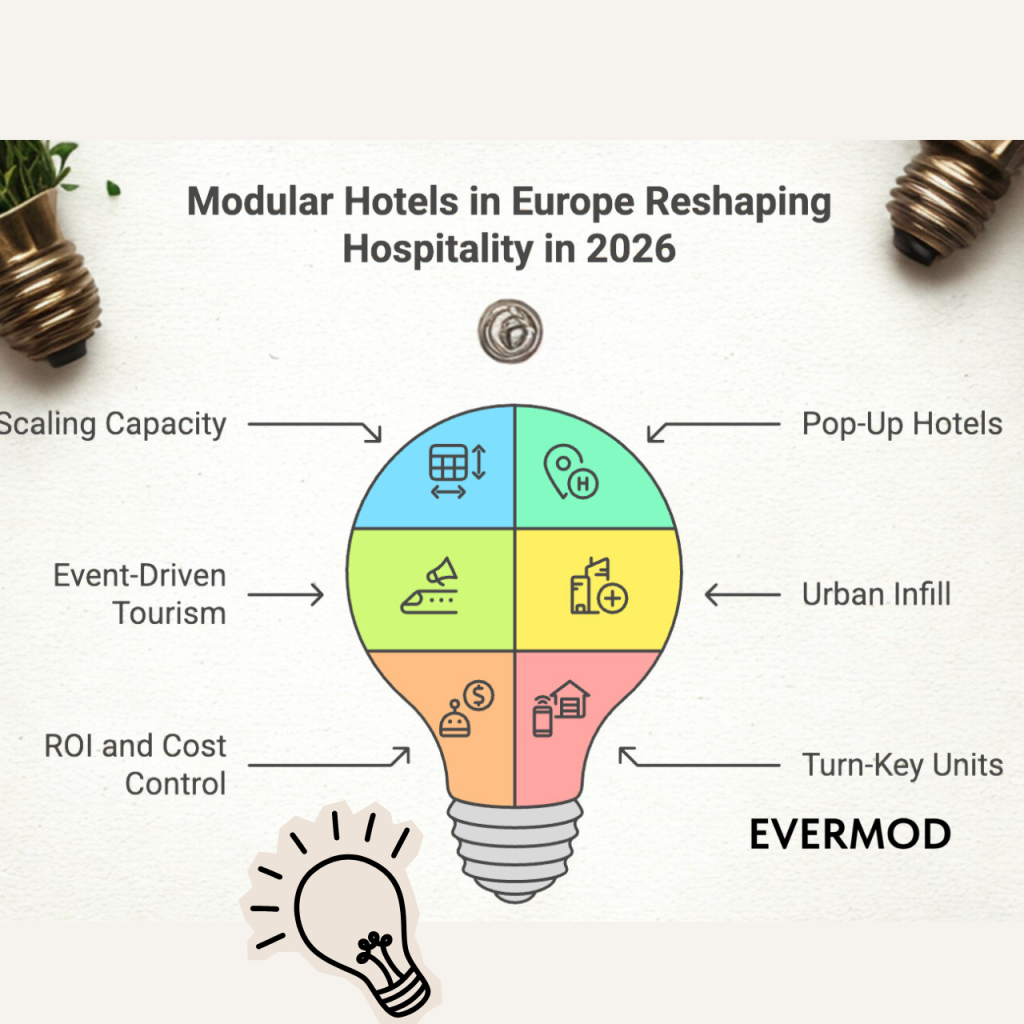
ROI, Cost Control, and Deployment Speed for Hotel Operators
Beyond speed, modular hotels appeal to operators due to their financial predictability. Traditional hotel builds often face cost overruns due to material price fluctuations, labor shortages, and weather-related delays. These variables make forecasting difficult and increase investment risk. Scalable hotel solutions based on modular construction offer more control. Factory production enables bulk material purchasing, standardized processes, and clearer cost structures. With fewer unknowns, developers can forecast capital expenditure more accurately and reduce contingency buffers.
As we mentioned before, faster deployment also means faster revenue generation. Hotels begin operating sooner, shortening the path to break-even and improving overall return on investment. For operators planning multi-location rollouts, modular systems simplify replication across regions.
The Rise of Turn-Key Modular Hotel Units
One of the most important developments in modular hospitality is the rise of turn-key modular hotel units. In this context, “turn-key” means that units arrive fully finished and ready for immediate use. We hope you learned what “turn-key” is by now, reading our blog. Turn-key modular hotel units typically include completed interiors, bathrooms, lighting, insulation, and fixtures, with minimal on-site finishing required. This reduces coordination complexity and shortens installation timelines significantly.
For hotel brands, turn-key units support design consistency across multiple locations while allowing for customization where needed. They also reduce operational complexity by minimizing post-installation work, inspections, and delays. This approach aligns closely with modern hospitality strategies focused on speed, consistency, and scalability.
Developers exploring modular hospitality concepts often reference existing modular hotel projects and modular short-term rental models when evaluating this approach. For example, insights from eco-friendly modular hotels gaining traction across Europe help illustrate how modular construction adapts to different hospitality formats. Similarly, modular accommodation designed for short-term rentals, such as modular homes used as Airbnb investments, demonstrates how turn-key units support fast market entry in flexible hospitality models.
Modular Hotels vs Traditional Builds in 2026
As the industry looks toward 2026, the differences between modular hotels and traditional construction are becoming more pronounced. According to data from the UN World Tourism Organization (UNWTO), Europe continues to experience increasingly fragmented travel demand, with shorter booking windows and stronger peaks around events and seasons, reinforcing the need for flexible accommodation models. Modular hotels in Europe consistently outperform conventional builds in timeline reliability, labor efficiency, and expansion flexibility.
Traditional hotels require large on-site labor teams and extended construction phases, making them vulnerable to workforce shortages and scheduling disruptions. Modular hotels reduce on-site dependency and allow operators to add capacity incrementally rather than committing upfront. Another key distinction is asset mobility. Modular hotel units can be relocated, reconfigured, or repurposed, offering long-term flexibility that traditional buildings cannot match. In a market shaped by uncertainty, adaptability is becoming a defining asset.
Conclusion: Why Modular Hotels Are Becoming a Core Hospitality Strategy
Modular hotels are no longer a niche solution. Across Europe, they are becoming a core hospitality strategy for operators seeking speed, scalability, and financial predictability. As tourism demand becomes more dynamic and construction challenges intensify, the ability to deploy high-quality accommodation quickly is a competitive advantage.
By 2026, modular hotels are expected to continue expanding across urban centers, seasonal destinations, and event-driven markets. Recent insights from Eurostat’s tourism statistics show sustained growth in short-stay travel and city breaks across the EU, a trend that favors fast-deploy and scalable hotel formats. For developers, investors, and operators, understanding how turn-key modular hotel units fit into modern hospitality models is no longer optional; it is part of building resilient, future-ready accommodation strategies.
So, for those exploring new hotel concepts, scalable modular solutions offer a practical way to respond to today’s realities while remaining flexible for tomorrow’s opportunities.