
Modular Homes in Europe: The Hidden Cost of “Waiting to Build” in 2026

Table of Contents
Across Europe, thousands of people are postponing their plans to build, which raises the hidden cost of waiting to build. Not because they lack intent, but because traditional construction forces them to wait for the “right moment”, lower interest rates, cheaper materials, faster permits, or more predictable timelines. On paper, that caution makes sense. Why commit to a long, uncertain build when the market feels unstable? That’s where modular homes in Europe come in to help!
The problem is that in today’s European construction landscape, waiting is rarely neutral. Traditional building methods are slow, exposed to price swings, and heavily dependent on external factors, which means every delay quietly adds cost and risk.
For anyone looking at modular homes in Europe, or considering turn-key modular homes as an alternative, the real cost of waiting often doesn’t show up immediately. It appears over time through rising building costs, lost months (or years), shrinking land options, and missed opportunities. As Europe moves toward 2026, those hidden costs are becoming harder and more expensive to ignore.
Why “waiting” feels safe, but often isn’t
The idea of waiting is rooted in caution. European construction has experienced volatile years, marked by supply chain disruptions, inflation spikes, and labor shortages. Many future homeowners assume prices will stabilize if they simply pause long enough.
However, the European construction industry isn’t resetting to pre-2020 conditions. It’s restructuring. Labor shortages are structural, not temporary. Energy standards are tightening permanently. Material costs may fluctuate, but they are stabilizing at a higher baseline than before.
According to a recent analysis by Bain & Company on Europe’s construction sector, even as the market shows early signs of recovery, long-term cost pressures remain embedded due to workforce constraints, productivity gaps, and regulatory complexity. The report highlights that construction across Europe is entering a phase where efficiency matters more than scale, and delays often compound costs rather than reduce them.
In simple terms, waiting does not freeze conditions in place. It lets them move on without you. Many of these concerns are already being addressed across Europe, as modular construction becomes more regulated, standardized, and widely adopted, something we explore in more detail in Modular Housing in Europe Today: What 2026 Buyers Need to Know.
Building costs in Europe are not standing still
One of the most overlooked aspects of waiting is how quietly building costs rise. Not dramatically, not headline-worthy every month, but steadily. Labor rates adjust. Compliance requirements evolve. Energy performance standards become stricter. Each of these adds cost, even when material prices stabilize.
Construction producer price data across the EU shows that building-related costs have experienced sustained upward pressure over recent years, reflecting higher input prices and operational expenses for contractors. This trend affects both residential and infrastructure projects and has proven resistant to short-term market corrections.
For someone planning to build in 2026, this means that postponing a project by a year or two rarely results in savings. More often, the same house simply costs more to deliver later, even if interest rates or material prices fluctuate in your favor.
The time cost no one budgets for
Financial cost is only one part of the equation. Time itself carries value, especially in housing.
Every year spent waiting is a year not living in the home you designed. It’s another year of rent payments, temporary housing, or compromised living arrangements. For families, it may mean postponing stability. For remote workers, it may mean continuing to live somewhere that no longer fits their lifestyle. For investors, it often means lost rental income.
Traditional construction timelines in Europe frequently stretch between 12 and 24 months, and that’s assuming everything goes smoothly. Planning approvals, contractor availability, weather delays, and on-site complications all add uncertainty. Waiting to start does not shorten this process later; it simply shifts it forward in time.
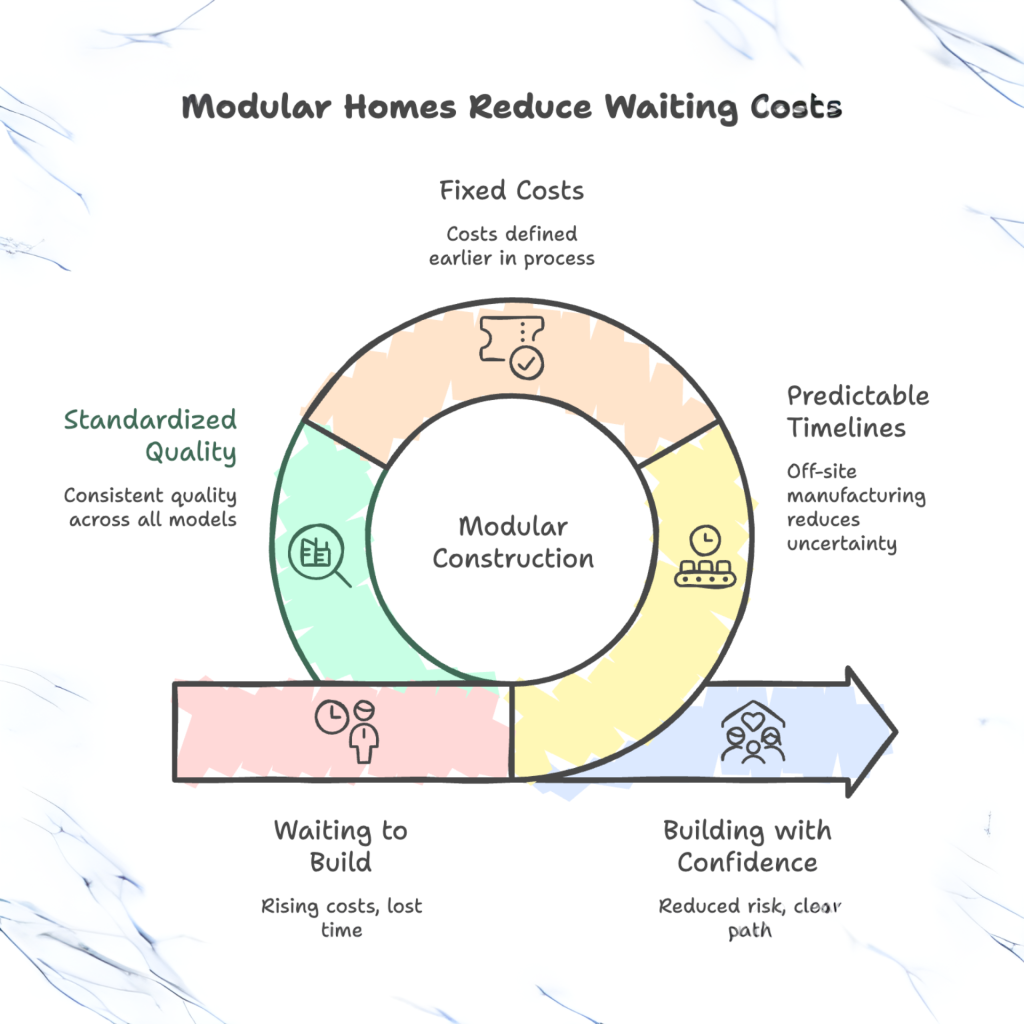
This is where turn-key modular homes change the equation. Because manufacturing happens off-site in controlled factory conditions, timelines become more predictable. While no construction process is instant, modular delivery compresses uncertainty rather than extending it.
Regulations are tightening, not relaxing
Another hidden cost of waiting to build is regulatory drift. European building regulations evolve continuously, especially around energy efficiency, emissions, and accessibility. Homes approved today may require additional upgrades tomorrow.
By waiting, future builders risk designing to a moving target. What meets standards now may require redesign later. This can lead to higher insulation requirements, upgraded systems, or more complex approvals, all of which add cost and time.
Modular homes in Europe are often better positioned for this reality because factory-based construction allows systems and specifications to be updated efficiently across models. Traditional site builds, by contrast, absorb regulatory changes one project at a time, often at higher cost.
Shrinking choices over time
Waiting also reduces choice, particularly when it comes to land, skilled labor, and delivery slots.
Affordable plots near infrastructure are not increasing in number. Skilled construction workers are not flooding back into the industry. Factory production capacity for modular housing is finite and increasingly booked in advance.
Those who commit earlier often gain access to better locations, more flexible design options, and clearer delivery schedules. Those who wait are left choosing from what remains.
This doesn’t mean rushing blindly. It means recognizing that decisiveness itself has value in a constrained market.
Why modular homes change the risk profile
The appeal of modular homes in Europe is not just speed, but control. Costs are defined earlier. Timelines are clearer. Quality is standardized. And most importantly, uncertainty is reduced.
For example, family-sized modular models like the Evermod Barn are designed with fixed specifications, predictable timelines, and clear performance standards, which significantly reduces the financial uncertainty many European buyers face today.
Turn-key modular homes shift much of the risk away from the homeowner and into a controlled production environment. Instead of reacting to delays, weather, or subcontractor availability, the process becomes planned, repeatable, and transparent.
In a market where waiting amplifies risk rather than reducing it, this predictability becomes a form of financial protection.
The emotional cost of indecision
There is also a human side to waiting that rarely appears in market reports. Prolonged indecision creates stress. Projects linger in the background of life, unresolved. Families delay plans. Individuals put their lifestyles on hold.
Building a home is not just a financial act; it’s a life decision. The longer it remains hypothetical, the heavier it becomes.
Those who move forward often report a sense of relief once the process begins, even in imperfect conditions. Clarity replaces speculation. Progress replaces hesitation.
Waiting feels cautious, but action can be smarter
In today’s European housing landscape, waiting is often framed as prudence. But prudence depends on context. When costs rise gradually, regulations tighten, and capacity shrinks, inaction becomes a choice with consequences.
Modular homes in Europe offer a way to move forward without embracing unnecessary risk. They don’t promise miracles. They offer structure, predictability, and adaptability in a market that increasingly rewards those qualities.
The real hidden cost of waiting to build is not just money. It’s time, options, momentum, and peace of mind. And by 2026, those costs are no longer abstract. They’re measurable, lived, and increasingly difficult to reverse.