
How Modular Construction Is Solving Europe’s Housing Crisis One Unit at a Time

This blog post is different from what we are used to sharing. And for a good reason. Europe faces a housing shortfall on an unprecedented scale. With rising prices, shortages of affordable homes, and stalled traditional construction, the built-environment sector is under pressure. Modular construction offers a viable and scalable solution, and at Evermod, we believe that each modular unit is important. Let’s have a look at the most authoritative sources to see how this housing crisis is developing and how we intend to be a part of the solution.
Europe’s Housing Shortage: The Reality
According to a recent report from CBRE, Europe faces an estimated shortage of 9.6 million homes, representing about 3.5 % of the current housing stock. Additional data from Eurostat highlights affordability issues: in 2023, 10.6 % of households in cities across the EU spent over 40 % of their disposable income on housing costs. These challenges are not just numerical; they are social. More than 13 million people in the EU experienced housing difficulties over the past five years, according to the European Investment Bank. In short, supply is declining, demand is growing, and many European cities have effectively run out of affordable housing options.
Why Traditional Construction Struggles
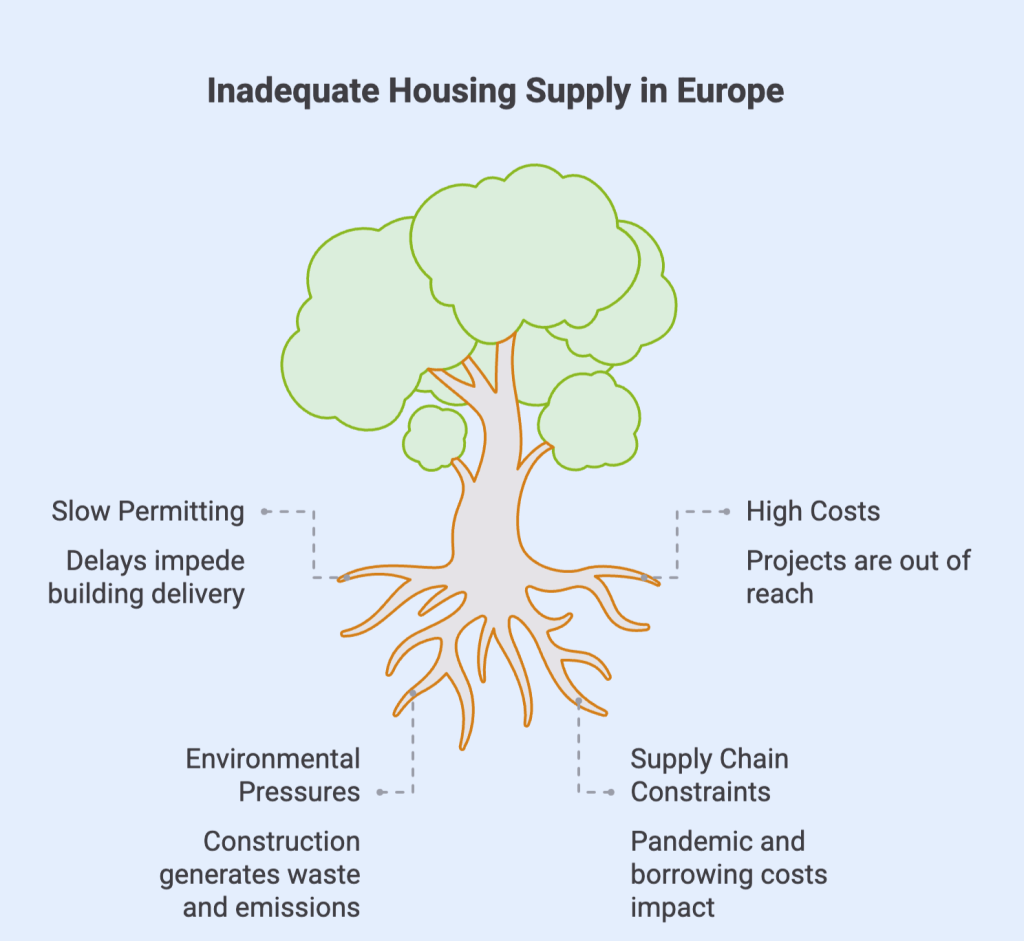
Several forces collide in the traditional construction sector. Some of them are:
- Slow permit processes and administrative delays impede building delivery.
- High labour and material costs push projects out of reach for lower-cost housing.
- Environmental pressures, with construction responsible for approximately one-third of global waste and nearly 40 % of CO₂ emissions.
- Supply chain and workforce constraints, especially following the pandemic and rising borrowing costs.
As a result, the pace of building new homes cannot keep up with Europe’s demand. In Germany, for example, although 320,000 apartments per year are needed, only 216,000 permits were issued in 2024, the slowest pace since 2010.
Modular Construction Is A Scalable Solution
Modular construction is industrialised building: homes or units built off-site in controlled factory environments, then transported and assembled on site. Several key advantages make it especially suited to address Europe’s housing crisis.
Speed & Efficiency
The World Economic Forum reports that modular construction can shorten project timelines by up to 50 %, thanks to reduced on-site work and fewer weather delays. Similarly, industry research shows modular (volumetric) homes command approximately 43.8 % of the European prefabricated housing market and are growing at a forecast CAGR of 7.19 % through 2030.
Cost & Waste Reduction
By centralising production, modular methods offer better cost control, less waste, and fewer change orders. For example, modular workflows can reduce total project cost by up to 20 % in certain situations.
Environmental & Social Impact
With its factory-based processes, fewer vehicle movements, and less disruption on site, modular building supports lower emissions and improved community outcomes. The World Economic Forum notes reduced waste, fewer vehicle deliveries, and improved circularity as major gains.
Market Readiness
As the modular sector expands, European prefabrication market reports show growth to USD 31.2 billion by 2032 (CAGR ~6.8 %).
Evermod’s Role: From Concept to Community
At Evermod, our mission is to harness the power of modular construction to deliver homes that are rapid, high-quality, flexible, and eco-aware. Here’s how we apply the above advantages:
- Our units are manufactured in a controlled environment in Latvia, enabling consistent quality, faster delivery, and scalability across Europe.
- Because each unit is turn-key, we reduce on-site disruption and client risk, helping build faster and more reliably.
- We use materials and processes aligned to low-carbon, high-efficiency goals, enabling our homes to be a part of the solution, not the problem.
- Whether used for affordable housing, second-home cabins, or modular communities, our models adapt to different use cases: from single-family dwellings to multi-unit plots.
By applying these capabilities, Evermod is ready to contribute to the housing deficit one unit at a time.
Real-World Impact: Unit by Unit
Imagine the effect: if a developer or municipality deploys 500 Evermod units in a year instead of waiting for traditional construction to deliver 300 homes, that accelerates occupancy, utilises less labour, wastes less material, and improves the housing stock sooner.
This is not hypothetical. The European market for modular is already moving accordingly. According to a Build-Up report, off-site construction is becoming a strategic lever to reduce cost and schedule risks across EU states.
Challenges & the Road Ahead
Of course, modular isn’t a silver bullet. A few barriers remain:
- Regulatory fragmentation: Building codes and approvals still vary widely across European countries and regions.
- Logistics & transportation: Large volumetric modules require route coordination, larger cranes, or special transport permits.
- Supply chain adaptation: Factories ready for mass production must scale carefully to preserve quality and local responsiveness.
- Perceptions: Traditional construction still dominates many markets, and convincing stakeholders to adopt modular takes leadership.
Yet, the momentum is clear: developers, cities, and investors increasingly see modular as a credible path forward.
Conclusion: Building Tomorrow’s Homes, Today
Europe’s housing crisis is urgent, complex, and deeply structural, but it is not unsolvable. Modular construction offers speed, efficiency, sustainability, and scalability, and Evermod is positioned to deliver real homes, not just concepts. In our view, every unit built means one less household waiting, one less family compromised by unexpected costs, one more building aligned to environmental goals. That is why we believe modular is more than a trend; it’s the future of European housing. Discover our models and how we help solve this challenge: Evermod Models.