
How Much Insulation Do You Really Need? A Realistic Look at Energy Efficiency in Modular Homes

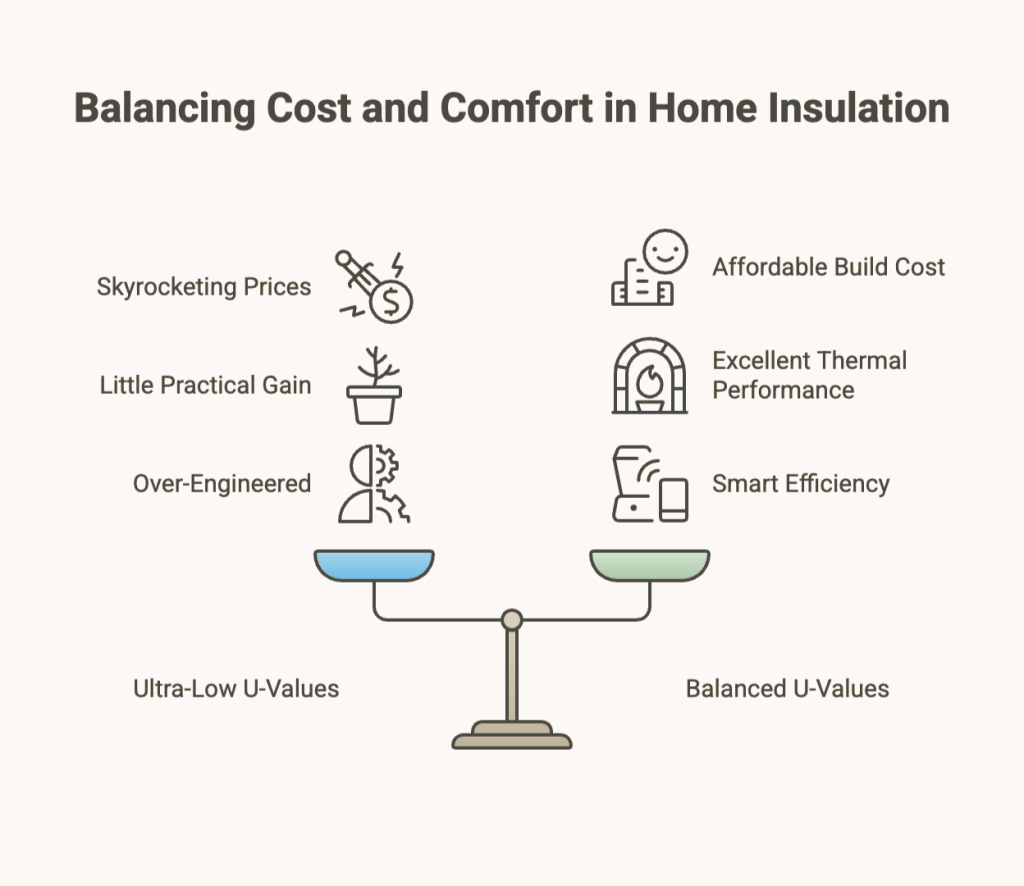
When it comes to insulation, more isn’t always better. In the rush to meet new efficiency standards, many builders forget that comfort, cost, and common sense should go hand in hand. Ultra-low U-values might sound impressive on paper, but they often lead to skyrocketing prices and little practical gain. At Evermod, we believe the smartest homes are those that strike a balance, staying warm when it’s cold and cool when it’s hot, and are built with efficiency that makes sense both environmentally and financially.
So When “More” Isn’t Always “Better”
If you’ve ever thought, “I’ll just get the thickest walls possible so my house stays super warm,” this one’s for you. If you live in a southern country, you might want to learn why and how insulation works in warmer climates in our previous article. We all know someone who adds three extra jackets when it’s barely chilly, right? (They’re sweating by lunch.) Homes can be like that too, over-insulated, over-engineered, and overpriced for the actual climate they’re in. Sure, we could build a house so efficient you could heat it with one candle. But you’d pay so much for it, you might not even want to light that candle. Let’s unpack what insulation and U-values really mean, and why balance is smarter (and kinder to your wallet) than extremes.
Understanding U-Values: The “Fuel Efficiency” of Your Home
If a car that consumes 10 liters per 100 km is considered inefficient and one that uses 5 liters is excellent, then home insulation works much the same way. The U-value measures how much heat escapes through your walls. The lower the number, the better the insulation.
In modular home construction, a U-value of 0.10 is extremely efficient, like driving a car that barely uses any fuel. But Evermod homes already achieve 0.21, which is considered high performance by European standards.
The difference between 0.10 and 0.21 sounds small, but it can double the cost of a build. You could, in theory, heat such a home with a single candle, but would you really want to pay double the price for that? Efficiency should make sense, not make home ownership impossible.
Lessons from Finland and Latvia: When Standards Go Too Far
In Finland, log homes have long been part of the national identity. Traditionally, 20 cm solid log walls offered a U-value around 0.50–0.55, not the lowest, but perfectly adequate in a well-built home. However, as new energy regulations tightened (following EU efficiency directives), builders were required to meet much lower U-values, often around 0.21 or below.
To comply, many manufacturers began using thinner logs (100–150 mm) combined with extra layers of insulation. While this achieved the required efficiency, it also increased production costs and reduced the traditional look and feel of authentic log construction. Some builders and buyers began stepping away from classic solid-log houses altogether.
In Latvia, the situation evolved differently. Regulators adopted the same EU standards but introduced flexibility for traditional timber construction, allowing log-home manufacturers to meet performance requirements through alternative calculations and design methods. This approach helped preserve the craftsmanship and heritage of log building while still supporting the country’s energy efficiency goals.
Learn more about how insulation standards vary in Europe:
- European Commission — Energy Performance of Buildings Directive (EPBD)
- Build Up Europe: U-values and Energy Efficiency Explained
- Finnish Log House Association (Puuinfo.fi): Energy Efficiency and Log Construction
Smart Efficiency, Not Over-Engineering
At Evermod, we build homes that balance comfort, efficiency, and cost. Our wall systems achieve a U-value of 0.21, ideal for most European climates, providing warmth in winter and coolness in summer without unnecessary extra expense. Could we push for 0.10? Absolutely. But much like a Dyson hair curler, it’s technologically impressive, but not everyone needs to spend that much to achieve comfort. When efficiency gets too extreme, prices grow disproportionally. Evermod’s approach is to stay at the sweet spot:
- Excellent thermal performance
- Affordable build cost
- Comfortable living all year round
The Evermod Max Model, Built for Extreme Conditions
The Evermod Max is our premium model, engineered for colder regions such as Finland, Austria, or the Alps. Its 300mm wall thickness and solid construction provide exceptional insulation and durability, but that’s only part of the story.
What makes the Max special:
- Delivered as a single, 50m² ready-to-live unit, no assembly required
- One of the only 15-meter modular homes in Europe, which is delivered in one piece
- Built with solid structural beams, allowing greater stability and insulation layers
In short, the Max is more than just “well-insulated”; it’s ready to live in the moment it arrives. Discover the Evermod Max model and see what makes it the warmest and most advanced modular home in our collection.
Who the Max Model Is Designed For
The Max isn’t for everyone; it’s for people who value comfort, time, and flexibility.
Think of:
- Ski or mountain enthusiasts who want a turn-key chalet in colder climates
- Property investors seeking ready-to-rent modular units
- Luxury resort owners or developers who value quick installation and premium quality
- Adventure and leisure property owners, golf resorts, yacht clubs, or rural retreats
When you invest in the Max, you’re not just buying a modular home; you’re buying time, comfort, and mobility.
Final Thoughts: Balance Is the True Luxury
Regulations are pushing for increasingly low U-values, and while innovation is important, not every home needs to meet laboratory-level insulation standards. At Evermod, we believe in smart efficiency, homes designed for real lives and real climates, because energy performance should empower people to build and live comfortably, not make it harder to own a home. Explore more on how Evermod builds smarter, not just warmer, with our Technology and Sustainability approach.