
How to Diversify Your Real Estate Portfolio in Europe (Beyond Apartments)

Table of Contents
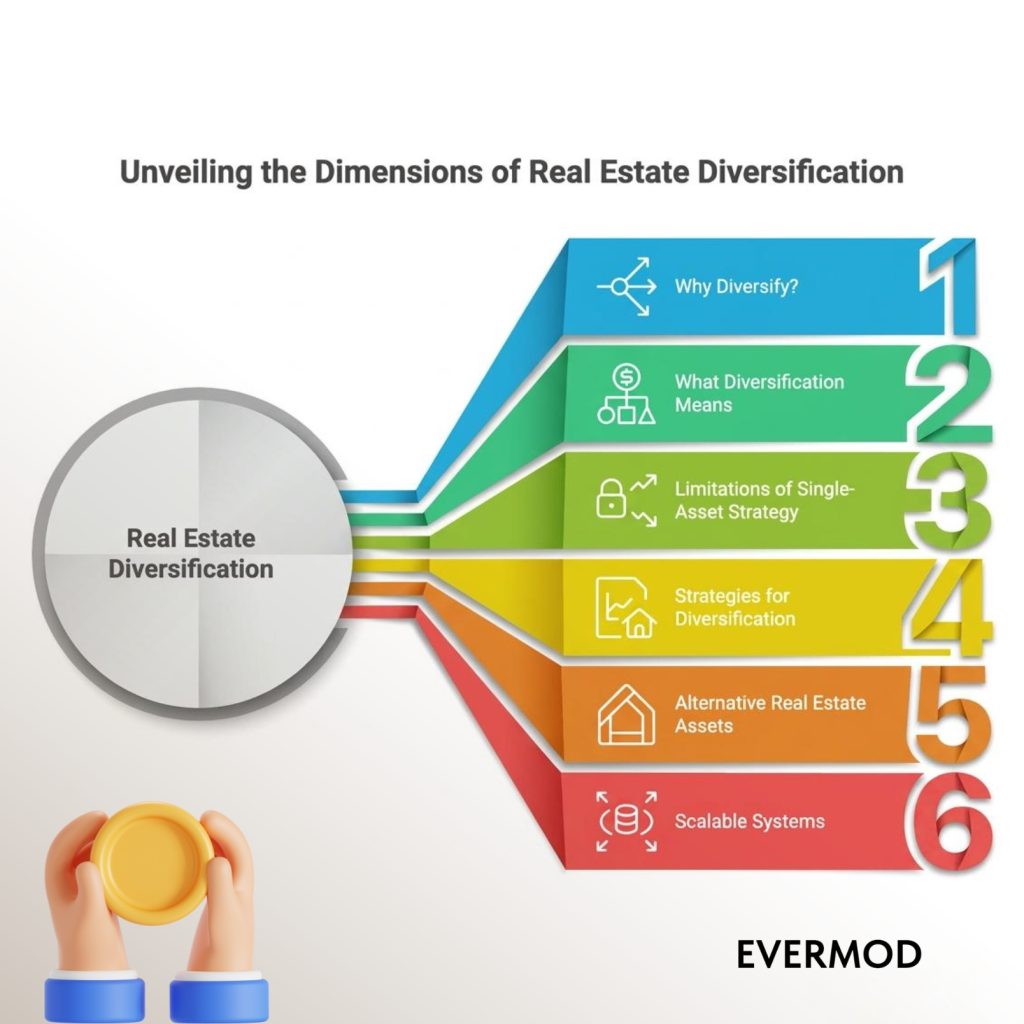
Why Investors Are Rethinking Traditional Property Strategies
For decades, the standard approach to building wealth through real estate in Europe was straightforward: find a growing city like Berlin or Paris, buy a two-bedroom apartment, and hold it. While this model still functions, it creates a significant “concentration risk.” By putting all your capital into a single front door, you are tethering your financial future to one specific street and one set of local regulations.
In 2026, the landscape is remarkably different. Rising property prices in major hubs have compressed yields, making it harder to find “cash-flow positive” urban units. As a result, the decision to diversify your real estate portfolio in Europe has evolved from an advanced tactic for the wealthy into a fundamental necessity for any individual investor.
What Real Estate Portfolio Diversification Really Means
At its core, property diversification is about spreading risk across different assets, locations, and income streams. It is the real estate equivalent of not putting all your eggs in one basket. Instead of relying on a single apartment to generate a 4% yield, modern investors are allocating capital across multiple opportunities that behave differently under changing market conditions. This “de-correlation” of assets is the secret to a resilient portfolio.
This could mean combining a traditional urban rental with a high-yield short-term stay in a coastal region. According to the European Central Bank, over-concentration in a single asset class, like urban residential, can significantly increase your exposure to economic shocks. To protect your capital, you must learn how to diversify your real estate portfolio in Europe by looking at rural locations where land is cheaper and demand for “experiential” stays is booming. You can explore their findings on these vulnerabilities in the ECB report on real estate market risks.
The Hidden Limitations of a Single-Asset Strategy
Owning one apartment in a major city may seem safe, but your income is tied to a single tenant. If they leave, your cash flow drops to zero overnight. Furthermore, urban apartments are subject to aggressive interventions, from rent freezes in Berlin to strict licensing in Barcelona. The “regulatory risk” of being a city landlord has never been higher.
Additionally, the high entry cost of traditional apartments often prevents expansion. If a Tier 1 apartment costs €450,000, your capital is “locked” for years. As highlighted in the European Parliament’s 2026 briefing on the housing crisis, house prices in the EU have surged by over 50% in the last decade. These structural imbalances reinforce why you should diversify your real estate portfolio in Europe rather than relying on a single asset at the top of a market cycle.
Strategies to Diversify Your Real Estate Portfolio in Europe
A new generation of investors is approaching strategy with a “Lego-style” mindset. They look for assets that can change their “skin” depending on the market. A property that serves as a mid-term rental for digital nomads in the spring and a vacation stay in the summer offers protection that a standard 12-month lease simply cannot match.
This often includes mixing different property types to balance the portfolio’s “barbell.” On one end, you have stable urban assets. On the other, you have high-yield, flexible assets that can be scaled. Many of our clients explore underutilized land to enter the market at a lower price point. If you’re considering this, our guide on buying land in Europe as a foreigner provides a practical overview of regional differences.
The Role of Alternative Real Estate Assets
As the goal to diversify your real estate portfolio in Europe becomes the primary focus, alternative assets like modular and prefab housing are moving to the mainstream. These are not intended to replace traditional apartments but to act as a high-speed, high-yield complement to them.
The ability to deploy a high-end modular unit on a coastal plot in months opens up strategic agility that was previously impossible. This is linked to the growth of “slow tourism.” Travelers no longer want a generic city apartment; they seek unique, experience-driven stays. By placing a premium modular unit in a high-demand natural region, an investor can capture a much higher nightly rate than a city-center studio, often for a fraction of the investment cost.
Moving From Fixed Assets to Scalable Systems
Perhaps the most significant shift is the transition from “buying a house” to “building a scalable system.” Traditionally, real estate was a “fixed” purchase. Today, the move is toward smaller modular units that allow for gradual expansion. Instead of waiting ten years to save for a second apartment, you can add a new unit as soon as cash flow supports it.
This approach creates a resilient structure. If you have five units across three locations, your performance isn’t dependent on one tenant. You have five different chances to win every month. This scalability is exactly how professional investors diversify your real estate portfolio in Europe while maintaining the ability to test new markets with minimal risk.
Where Modular Living Fits Into the Strategy
Modular housing has emerged as a financial tool that allows investors to “activate” land that might otherwise sit idle. Whether it is a vineyard in Tuscany or a forest plot in Scandinavia, modular units turn land into an income-generating asset without the logistical headaches of traditional on-site construction.
While modular homes aren’t a “one-size-fits-all” solution, they fill a gap: the need for high-margin, flexible income. They allow you to experiment with short-term rental models in emerging hubs. For those wanting to look at the numbers, our article on modular homes as an investment in Europe offers deeper insights into ROI and long-term value.
Balancing Risk, Flexibility, and Long-Term Value
Diversification is not about abandoning traditional strategies; it is about balance. A well-structured portfolio in 2026 might still include a classic apartment in a stable market like Warsaw to provide a solid “floor” of appreciation. However, that base must be complemented by assets that offer immediate returns.
The key is ensuring assets respond differently to market changes. When urban markets are slow, nature tourism might be peaking. By choosing to diversify your real estate portfolio in Europe, you combine stability with flexibility, allowing you to navigate the inherent uncertainty of the global economy.
Conclusion: A Smarter Way to Think About Real Estate
The old idea of owning a single, static asset is giving way to dynamic, diverse approaches. Building a sustainable income stream requires a roadmap. The future of real estate isn’t just about the bricks and mortar; it’s about how intelligently you diversify your real estate portfolio in Europe to withstand whatever the market throws at you next. The most effective strategy is no longer about choosing one path, but about learning how to build a map that covers them all.