
Construction Trends Shaping European Homes in 2026

A Quiet Shift In Construction Trends is Redefining How Europe Builds
Table of Contents
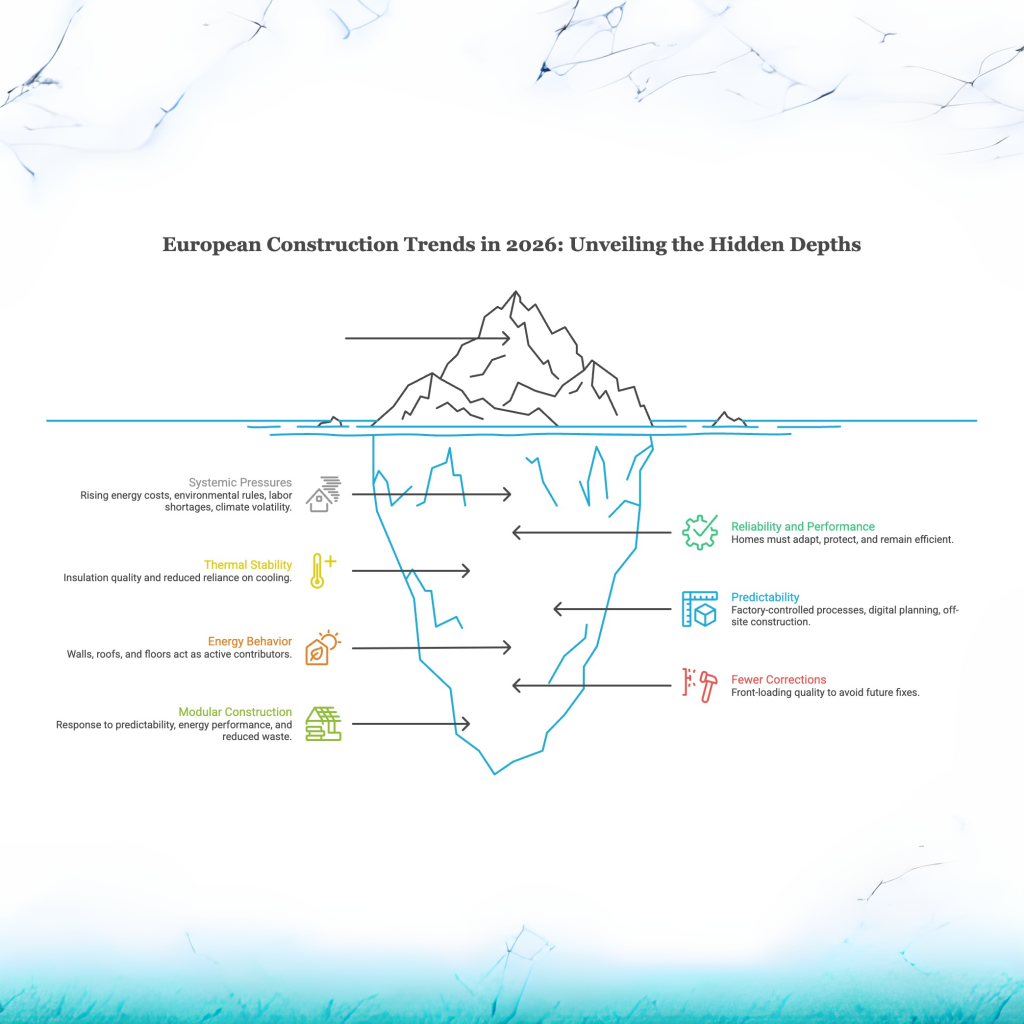
We have arrived at 2026, construction in Europe looks less like a noisy building site and more like a coordinated production process, not because of hype, but because the pressures shaping the industry have quietly changed. Rising energy costs, tighter environmental rules, labor shortages, and climate volatility are forcing builders, buyers, and developers to rethink what “normal” construction even means.
The future of construction in Europe is no longer defined by spectacular innovation alone. It is defined by reliability, predictability, and performance over time. Homes are expected to do more than stand still; they must adapt, protect, and remain efficient in conditions that are becoming less predictable each year.
This shift is increasingly reflected in global construction foresight research. Industry analyses such as ITONICS’ overview of long-term construction trends highlight how systemic pressures, not aesthetics, are now driving how buildings are designed and delivered across Europe.
If You’re Building in Southern Europe in 2026, the Priorities Look Different
Imagine planning a home in Portugal, Spain, or Southern Italy in 2026. Summer heatwaves are longer. Energy prices fluctuate. Municipalities are stricter about performance certificates. What matters most is no longer just aesthetics or square meters, but how the building behaves during extreme conditions; that’s where modular construction in Europe comes in.
In these regions, construction decisions increasingly revolve around thermal stability, insulation quality, and reduced reliance on mechanical cooling. Homes that overheat during the day and struggle to cool at night are already being seen as outdated. Read our article about the importance of insulation in warm climates, and you will understand. Buyers are learning quickly that poor thermal design translates directly into discomfort, higher bills, and long-term regret.
This aligns with broader observations on how climate and regulation are reshaping the building industry. According to Kaizen’s global construction outlook toward 2026, resilience, energy behavior, and lifecycle performance are becoming central decision factors, particularly in regions facing rising temperatures.
Construction Is Becoming More Predictable, and That’s the Point
One of the most noticeable changes in the building industry heading into 2026 is the move away from uncertainty. Traditional construction has always carried unknowns: weather delays, labor availability, material waste, and cost overruns. In today’s economic climate, those unknowns are no longer acceptable to many buyers.
Across Europe, there is a growing preference for construction methods that reduce variability. Factory-controlled processes, digital planning tools, and off-site construction models are gaining momentum because they allow people to plan with confidence, not just timelines, but final performance, final cost, and final quality.
This is not about speed for speed’s sake. It is about eliminating surprises.
The Future Home Is Designed Around Energy Behavior, Not Just Layout
In 2026, energy efficiency is no longer a box to tick at the end of a project. It is shaping homes from the inside out. Walls, roofs, and floors are now expected to act as active contributors to comfort, not passive separators between inside and outside.
If you are planning a home in Europe, the question becomes: how long does heat take to enter the building? How stable is the indoor temperature when systems are off? How much energy is required to maintain comfort during peak conditions?
Expert perspectives gathered by Autodesk from construction leaders worldwide emphasize that future-ready homes are designed digitally first, with performance simulations guiding decisions long before construction begins.
Modern Construction Is About Fewer Corrections Later
Another behavioral shift shaping construction trends in 2026 is the desire to avoid future fixes. Buyers are increasingly aware that retrofitting insulation, upgrading systems, or correcting design flaws after construction is expensive and disruptive.
As a result, there is growing interest in construction that approaches front-load quality. Decisions made early about insulation thickness, air tightness, material compatibility, and structural precision determine whether a home ages gracefully or becomes a source of ongoing maintenance.
This mindset is especially common among people building second homes or relocating across borders, where reliability matters more than flexibility. That’s where modular construction in Europe really comes into play.
What This Means for Modular and Off-Site Construction
Rather than positioning modular construction as a trend, it is more accurate to see it as a response to these evolving expectations. Off-site construction aligns naturally with the desire for predictability, energy performance, and reduced waste.
By 2026, modern construction methods in Europe increasingly favor systems that are tested before installation. Homes are expected to arrive on-site already optimized, not adjusted in the field. For additional context on how this shift is already shaping buyer decisions, you can read the modular guide for buyers in 2026.
The Evermod Perspective: Building for Stability, Not Short-Term Gains
At Evermod, these changes are not viewed as abstract industry movements. They reflect the real questions customers ask before committing to a home. Will this house stay comfortable in extreme heat? Will energy costs remain manageable? Will the building still meet standards in ten years?
That is why Evermod homes are designed with high-performance insulation, precision manufacturing, and turn-key delivery as standard. The goal is not to react to future regulations, but to anticipate them.
Looking Ahead to 2026 and Beyond
The future of construction in Europe is not defined by a single technology or material. It is defined by a shift in mindset. Homes are no longer judged only by how they look on day one, but by how they behave over decades.
The smartest construction decisions in 2026 will be those that reduce uncertainty, improve comfort, and respect long-term energy realities. The homes that succeed will not shout innovation; they will quietly perform, year after year.