
Can You Really Build a Modular Home Anywhere? (Europe Edition)

Understanding land, zoning, terrain, and climate for your Evermod modular home.
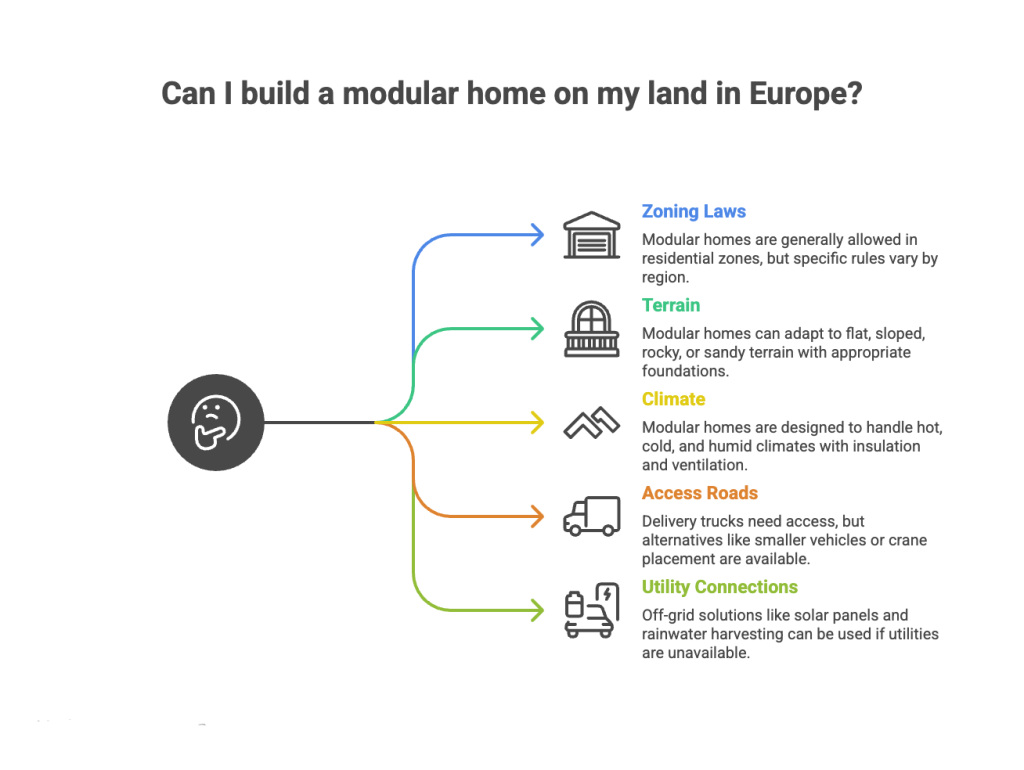
When people fall in love with the idea of modular living, their next concern is almost always the same: “Can I actually place a modular home on my piece of land?” We get this question all the time. And it’s a normal question, especially in Europe, where every country, and often every region, has its own rules about land use, zoning, and construction. In most cases, yes, you can build a modular home almost anywhere, as long as the land allows residential construction. This article explains how zoning, terrain, climate, and utility access affect your options, and why Evermod’s turn-key modular homes are surprisingly flexible in all these situations.
Are Modular Homes Allowed Everywhere? Understanding European Zoning Laws
The simple answer is that modular homes are permitted in almost all locations where traditional homes are allowed. European zoning laws typically focus on what type of construction is permitted, not how it is built. This means that modular homes usually fall under the same residential regulations as traditional homes. Land-use rules vary by region, and national planning offices often use environmental data from the European Environment Agency (EEA) when determining development limits and rural building guidelines.
Building in Rural Areas
Rural areas across Europe are often the most flexible places to install modular homes. Municipalities in these regions generally welcome low-impact construction, and modular homes are known for producing less noise, fewer disturbances, and much faster installation times compared to traditional building methods. They also require fewer heavy vehicles and less on-site construction, which helps preserve the natural environment. Countries such as Portugal, Spain, Estonia, Lithuania, Croatia, and Sweden are particularly friendly to modular construction in rural zones, as long as the land meets basic requirements for access and safety.
Building in Suburban Areas
Suburban regions tend to have stricter rules regarding plot size, building height, distance from property boundaries, and sometimes exterior aesthetics. These areas also typically enforce the EU’s energy efficiency standards closely. The advantage is that Evermod’s modern modular homes already comply with high European performance requirements, making the approval process smoother than many people expect.
Building in Protected or Agricultural Zones
Protected nature reserves, agricultural land, forest zones, and national parks can be more challenging. Some of these areas are part of Natura 2000, the EU-wide network of protected habitats, where construction may be limited or require special approval. However, even restricted zones sometimes allow modular homes because they are far less invasive and leave a lighter footprint on the land. Approval is always case-by-case, but modular construction often has a stronger argument than traditional building.
Can Modular Homes Be Placed on Any Terrain?
Many people assume that modular homes require perfectly flat land, but this is not true. Modular housing works on a surprisingly wide range of terrain types.
Flat Land
Flat land is ideal because it generally requires the least preparation, which speeds up the installation process. Evermod homes can be placed on simple foundations such as concrete pads, strip foundations, or ground screws, which are fast and cost-effective.
Sloped Land
Sloped plots can also accommodate modular homes. Depending on the gradient, Evermod can install elevated supports, reinforced ground screws, or tiered foundations that follow the slope without needing heavy excavation. This approach preserves the natural shape of the land and keeps costs much lower than leveling the entire area.
Rocky or Hard Terrain
In many southern European regions, such as parts of Portugal, Spain, Italy, and Croatia, rocky terrain is extremely common. Modular homes work well on these plots because the foundation points can be pre-drilled or anchored using modular support systems that adapt to the ground. Homeowners do not necessarily need to remove large rock formations or level the entire area.
Sandy or Soft Terrain
Coastal zones, dunes, and soft-soil areas require stronger foundation anchoring, but modular homes remain fully compatible. Deep ground screws, soil reinforcement techniques, and lightweight raised support structures help ensure long-term stability. Because modular homes weigh much less than brick houses, they place less pressure on the ground, making them more suitable for soft terrains.
Climate Compatibility: Can Modular Homes Handle European Weather?
Modular homes are engineered with energy performance in mind, which means they are designed to handle a wide variety of climates across Europe. Let’s have a look:
Southern Europe and Hot Climates
In hot regions such as Portugal, Spain, Italy, and Greece, homeowners often worry about overheating. Evermod homes are built with insulation that works for both warm and cold climates, and they can be upgraded with solar shading, ventilated façades, and smart ventilation systems that reduce heat buildup. UV-resistant cladding also helps maintain comfort even during the warmest summer days.
If you want to learn more about the importance of insulation in warm countries, you can read our related article here: Why Insulation Still Matters in Southern Europe
Northern Europe and Cold Climates
Modular homes are equally effective in very cold regions. They can be engineered with increased roof load capacity for snow, triple-glazed windows, airtight construction, and ventilation systems with heat recovery. Because modular homes are assembled in controlled environments, they often have better thermal performance than traditional homes built outdoors.
Coastal and Humid Regions
Coastal Europe experiences higher humidity and salt exposure. Evermod homes use moisture-resistant cladding, protected structural frames, and insulation that prevents condensation. The elevated airflow design also helps reduce moisture buildup, which is crucial for long-term durability.
Access Roads and Delivery: Can the Truck Reach Your Plot?
Evermod modular homes are delivered by truck, so access routes are important. Fortunately, most rural and suburban European roads already meet the basic requirements for delivery. In some cases, if a road is too narrow or has sharp turns, there should be some modifications made to allow crane placement, or even modular units delivered in two sections to ensure safe access. Temporary adjustments, such as removing a fence or trimming a tree branch, can also solve minor road limitations. Evermod and any other modular home builder should have a good understanding of the plot and terrain, to make the best decision and advice.
Utility Connections: Do You Need Electricity and Water Before Building?
You do not need fully installed utilities before placing a modular home, but you should ensure that your land has access to the essential services you plan to use. If water, electricity, or sewage connections are available nearby, Evermod can integrate the home with these systems once proper access and permissions are secured by the landowner. For plots without existing infrastructure, our homes can still operate through off-grid solutions. Solar panels, battery storage, rainwater harvesting systems, composting toilets, and greywater recycling can all be added. This flexibility allows homeowners to live comfortably even in remote or undeveloped locations.
A Quick Overview of Modularity Across Europe
Some countries are especially friendly to modular homes, including Portugal, Spain, Estonia, Lithuania, Sweden, Finland, Croatia, and Slovenia, where regulations are clear and the demand for sustainable housing is growing. Others, such as Germany, the Netherlands, Belgium, France, and Italy, also accept modular housing widely but may require additional documentation. Regions like Switzerland, Austria, Denmark, and certain protected islands are stricter, but modular homes can still be approved with the correct permits and environmental assessments.
So… Can You Build a Modular Home Anywhere?
In nearly 90 percent of situations across Europe, the answer is yes. Modular homes are permitted in most residential zones, adapt easily to many types of terrain, and withstand a wide range of climate conditions. The final decision always depends on local zoning rules, access conditions, the environmental status of the plot, and the availability of utilities. Evermod’s engineering flexibility, lightweight foundations, and off-grid options give homeowners far more freedom than they expect.
Ready to Find Out If Your Plot Is Suitable?
Evermod can help you evaluate whether your land is eligible and what steps should be taken to acquire proper documentation, what type of foundation is suitable, how delivery would work, and whether off-grid systems are necessary. You can explore our full collection of turn-key modular homes here: Evermod Models, and contact us whenever you are ready to start your modular journey!