Best Countries to Build a Modular House in Europe in 2026: Where Smart Buyers Are Building
Table of Contents
If you are planning to build in 2026, the question is no longer simply where land is cheapest. The real strategic question is: what are the best countries to build a modular house in Europe in 2026?
Across the continent, regulatory transparency, permit timelines, infrastructure strength, and long-term market stability now determine whether a project moves efficiently or becomes financially draining. With sustainability directives tightening and national construction frameworks evolving, understanding modular home regulations in Europe, conducting a proper building permit comparison in Europe, and identifying the easiest country to build in Europe are essential steps for serious buyers.
This guide evaluates the easiest country to build in Europe when it comes to modular construction in 2026 using a strategic framework focused on regulatory clarity, administrative efficiency, and long-term resilience.
If you are still assessing land affordability first, you can read our guide on The Cheapest Countries in Europe to Buy Land for a Modular Home – 2026 Guide.
And if you are reconsidering lifestyle priorities, our article Modular Home vs City Apartment: Why More People Are Making the Switch provides useful context. Now let’s examine strategy over price.
What Defines the Best Country to Build a Modular House in Europe in 2026?
The best country to build a modular house in Europe in 2026 is not necessarily the cheapest or the most popular. It is the country where administrative systems are predictable, zoning laws are transparent, sustainability requirements are clearly defined, and infrastructure supports long-term residential value.
Across the European Union, regulatory standards are shaped by directives such as the Energy Performance of Buildings Directive, enforced by the European Commission. This framework pushes all member states toward stricter energy efficiency and near-zero-emission targets, directly affecting modular construction requirements.
At the same time, national administrative efficiency differs significantly. A European Commission analysis shows that the time to obtain a building permit in EU member states can range from a few weeks to several months due to differences in modular home regulations in Europe, administrative capacity, and approval procedures, making a meaningful building permit comparison in Europe essential for strategic builders. This makes a serious comparison of building permits in Europe critical before selecting land.
The Smartest Countries in Europe for Modular Construction
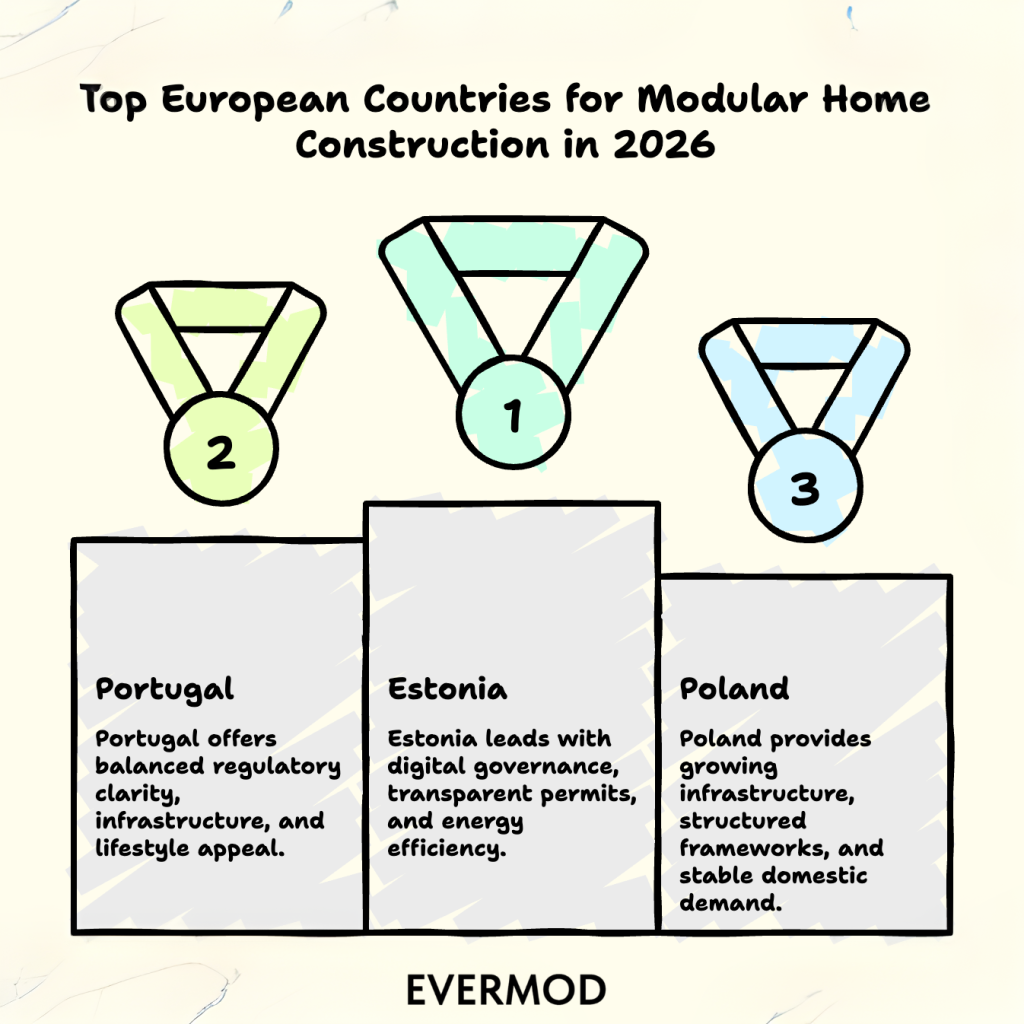
When evaluating the smartest countries in Europe, the focus shifts to regulatory intelligence rather than simple affordability. The following countries stand out in 2026 based on permit speed, regulatory transparency, infrastructure quality, economic stability, and rental or resale strength.
Portugal
Portugal remains one of the most balanced environments for modular construction in Southern Europe. Administrative processes have gradually digitalised, improving communication between municipalities and applicants. While timelines can still vary regionally, the regulatory system is structured and transparent.
Energy efficiency standards are aligned closely with EU directives, making Portugal compatible with high-performance modular builds. Infrastructure quality in coastal and central regions is strong, and growing remote work communities continue to support residential demand.
For buyers seeking lifestyle value combined with moderate regulatory clarity, Portugal ranks among the smartest countries in Europe in 2026.
Estonia
Estonia is often described as one of the most digitally advanced countries in Europe, and that reputation is well deserved. Much of its public administration runs online, which makes processes like building applications far more straightforward than in many other EU countries. Instead of navigating layers of paperwork, much of the system is transparent and accessible digitally.
If you’re looking for one of the easiest countries in Europe to build in, Estonia consistently ranks high for clarity and efficiency. While the climate demands strong insulation and energy performance standards, this actually works in favor of modern modular homes, which are already designed with energy efficiency in mind. Clear regulations combined with digital infrastructure make Estonia a practical and forward-thinking option for 2026.
Poland
Poland, meanwhile, offers a different kind of opportunity. Significant infrastructure investment over the past decade has strengthened regional development and connectivity. Although permit timelines can vary by municipality, the national construction framework is clearly structured. With steady housing demand and economic growth, Poland stands out as a balanced and strategically smart choice for long-term investors.
Germany
Germany maintains one of the most rigorous construction frameworks in Europe. Energy standards are strict, environmental compliance is detailed, and documentation requirements are comprehensive.
While this can extend permit timelines, it also ensures long-term structural and market stability. Germany consistently ranks high in economic resilience and mortgage market stability.
For buyers prioritising security over speed, Germany remains a strong contender in the building permit Europe comparison, even if it is not always the easiest country to build in Europe administratively.
Spain
Spain offers strong infrastructure and attractive residential regions, but permit processes can vary significantly across autonomous communities. Municipal discretion plays a greater role than in some Northern European systems.
For modular projects, understanding modular home regulations in Europe at the regional Spanish level is crucial. When managed properly, Spain offers high rental potential and strong lifestyle appeal, particularly in regions benefiting from international demand.
Is There Truly the Easiest Country to Build in Europe?
The idea of a single easiest country to build in Europe is appealing but overly simplistic. Administrative speed depends on municipal efficiency, land classification, environmental impact assessments, and zoning restrictions.
Estonia’s digital governance reduces paperwork friction. Portugal has improved municipal communication. Poland balances structure and flexibility. Germany prioritises regulatory thoroughness over speed.
The true determinant of ease lies in preparation. Conducting a proper zoning review, assessing environmental overlays, and confirming utility access before land acquisition often matter more than the country itself.
Modular Home Regulations Europe: Why Compliance Strategy Matters
Modular homes must comply with the same structural and safety standards as traditional construction. The difference lies in off-site fabrication efficiency, not regulatory exemption.
Under the revised Energy Performance of Buildings Directive (EPBD), EU member states are required to adopt and enforce minimum energy performance standards and progressively tighter energy use trajectories through their national building codes, aiming to improve energy performance and decarbonise the building stock by 2050.
Understanding modular home regulations in Europe requires examining national fire safety rules, energy certification thresholds, foundation engineering requirements, and utility integration standards. Misalignment between factory production specifications and local compliance requirements remains one of the primary causes of delays.
A strategic builder aligns modular design specifications with national energy frameworks before submitting applications.
Building Permit Europe Comparison: Where the Real Differences Appear
When you compare building permits across Europe, the differences quickly become more than just technical details. In practice, they can shape your entire project timeline.
One of the biggest distinctions is the system’s level of digitalization. In many Northern European countries, applications can be submitted and tracked online, which makes the process more transparent and efficient. In other parts of Europe, paperwork and in-person steps are still more common.
Another key factor is municipal autonomy. In some Southern European regions, local authorities have greater discretion in interpreting and applying rules. This can create flexibility, but it can also mean less predictability across municipalities.
Environmental regulations also vary depending on zoning classifications and regional planning frameworks, which can affect both documentation requirements and approval speed.
Historically, even World Bank construction permit benchmarks showed wide variation in procedures and timelines across EU member states. Although many systems have modernised, these structural differences still matter when planning a project today.
Market Stability and Long-Term Positioning
Identifying the best country to build a modular house in Europe in 2026 also requires evaluating macroeconomic stability.
Countries with diversified economies, strong financial systems, and stable population growth tend to offer stronger long-term protection. Germany and Poland perform well in this category. Portugal and Spain offer lifestyle-driven demand supported by international buyers.
Rental flexibility, remote work migration, and regional development initiatives increasingly influence residential demand patterns across Europe.
The smartest countries in Europe are those balancing regulatory clarity with long-term economic resilience.
Strategic Conclusion: Where Should You Build in 2026?
There is no single universal winner. The best country to build a modular house in Europe in 2026 depends on your strategic priority.
If administrative efficiency matters most, Estonia ranks highly. If lifestyle and rental appeal, combined with improving digital systems matter, Portugal performs well.
If long-term economic stability and regulatory certainty are your primary concerns, Germany and Poland provide structured environments.
The real advantage comes from preparation. Conduct a serious building permit Europe comparison, evaluate modular home regulations Europe, and assess local zoning before committing to land.
Europe in 2026 still offers a strong opportunity for forward-thinking modular homeowners. The smartest countries in Europe are not simply the cheapest. They are the ones where regulation, infrastructure, and market stability align with your long-term vision.
The decision is no longer about where land is cheapest.
It is about where building is smartest.