Building Requirements in the EU: What You Need to Know About Codes in the Netherlands, Germany & Norway
Table of Contents
Understanding Building Requirements in the EU has become one of the most important steps in planning any residential project. Whether you are developing a modular home, buying land for a custom build, or investing in sustainable housing, European construction standards are no longer just technical guidelines; they shape cost, design freedom, long-term value, and even how comfortable a home feels to live in.
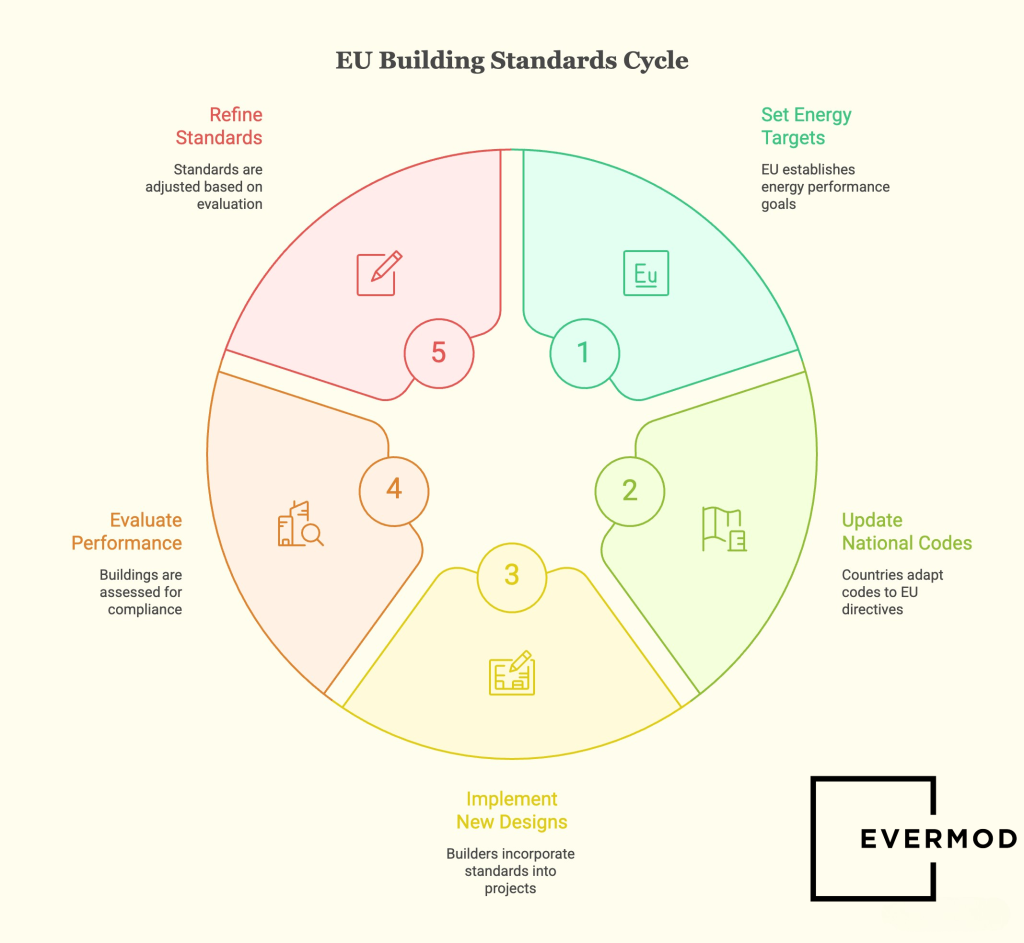
Across Europe, regulations are tightening. Energy performance targets are rising, fossil fuels are being phased out, and resilience to climate impacts, such as heavy rainfall, is no longer optional. While each country maintains its own building code, they all operate within a shared European framework driven by the Energy Performance of Buildings Directive (EPBD). The directive lays out the path toward a zero-emission building stock by 2050 and sets increasingly ambitious milestones for new construction.
When you look at countries like the Netherlands, Germany, and Norway, you begin to see how national interpretation of EU-level policy translates into very real design decisions on the ground.
Building Requirements in the EU: Why Energy Performance Now Drives Everything
Energy efficiency is no longer a bonus feature. It is central to how buildings are approved, financed, and valued. The shift is visible everywhere: stricter insulation requirements, renewable-integration requirements, heat-recovery ventilation systems, and limits on fossil-fuel heating systems.
Under the revised European framework, member states must continuously update their minimum energy performance standards and implement clear renovation roadmaps. The objective is not incremental improvement; it is structural transformation.
In practical terms, it means:
- Zero-Emission Buildings: From 2030, all new buildings in the EU are expected to meet zero-emission standards.
- Renovation Plans: Countries must submit national renovation plans outlining how they’ll upgrade existing stock.
- Minimum Performance Standards: Baselines for insulation, heating, ventilation, and renewable integration will continue to tighten.
These targets influence everything from architectural drawings to the selection of heating systems. For developers and land buyers, understanding these evolving European construction regulations early prevents costly redesigns later.
The Netherlands: Renewable Energy as a Structural Requirement
The Dutch approach to Building Requirements in the EU context stands out because of its strong renewable energy mandate. The Netherlands has aligned its national building regulations with aggressive decarbonization targets, placing renewables at the center of residential design.
New homes are expected to cover a substantial share of their energy demand through renewable systems such as solar panels or heat pumps. Rather than allowing fossil-based heating to compensate for poor insulation, the Dutch system integrates performance and renewable supply simultaneously.
Spatial standards also reflect careful planning. Ceiling heights, minimum room sizes, and accessibility criteria ensure livable interior environments. At the same time, rainwater management is tightly regulated. Given the country’s low elevation and water-sensitive geography, drainage systems must prevent overflow, surface flooding, and nuisance to neighboring properties.
If you are currently considering land acquisition in the region, the regulatory landscape directly impacts budgeting and feasibility. We explore this timing question in more detail in our article on whether 2026 is the right time to buy land in Europe.
Energy standards in the Netherlands do not just increase construction costs; they reshape the financial model of ownership by lowering operational expenses over time.
Germany: Technical Precision and Local Control
Germany approaches European construction regulations through a decentralized but technically rigorous framework. While overarching energy law exists at the national level, local zoning plans retain strong influence over building height, roof shapes, and site usage.
This combination of federal structure and technical standardization creates a highly detailed regulatory environment. Minimum room sizes, stair dimensions, acoustic insulation values, and fire safety provisions are precisely defined. Rainwater management is another critical area. Stormwater and sewage systems are typically separated, and slope requirements for drainage pipes are clearly specified to ensure proper flow and prevent structural damage.
Energy compliance in Germany focuses on overall building performance calculations rather than mandating a fixed renewable percentage. The logic is performance-based: achieve the required efficiency level through insulation, airtightness, or renewable systems. However, as EU targets tighten, renewable integration becomes increasingly common in practice.
For builders and modular manufacturers, this means early planning is essential. Retrofitting compliance later can be expensive and time-consuming. This is particularly relevant when evaluating emerging construction models, which we discuss in more detail in our article about construction trends that are shaping Europe.
Germany illustrates how Building Requirements in the EU can vary in implementation while still moving toward the same climate objectives.
Norway: Extreme Climate, Extreme Standards
Although Norway is not an EU member, it aligns closely with European energy directives through the EEA agreement. Its national building code, TEK17, is widely considered one of the most demanding in Europe.
The climate explains much of this. Long winters and high heating demands require superior insulation levels. Wall, roof, and floor U-values are significantly stricter than in many other European countries. Balanced mechanical ventilation with high heat recovery efficiency is mandatory, ensuring that indoor air quality is maintained without sacrificing thermal performance.
Norway has also effectively phased out fossil-based heating systems in standard residential buildings. Electrification and renewable solutions dominate the market. Importantly, installing a heat pump does not replace insulation requirements. The building envelope must still meet strict standards independently of mechanical systems.
Safety regulations further reinforce Norway’s performance-driven mindset. Hardwired, interconnected smoke detectors are compulsory, and accessibility provisions are deeply integrated into standard residential design.
This holistic model reflects the broader European direction: energy performance, safety, and resilience are inseparable components of modern housing.
The Broader Shift in Building Requirements in the EU
Looking across the Netherlands, Germany, and Norway, a clear pattern emerges. The specifics differ, but the direction is unified.
Insulation standards are rising. Renewable integration is becoming standard practice. Mechanical ventilation systems are replacing reliance on natural airflow in colder climates. Drainage requirements are increasingly linked to climate adaptation strategies.
What once felt like separate technical disciplines, energy modeling, fire safety, acoustics, and stormwater management, are now integrated into a single regulatory philosophy focused on performance and sustainability.
For anyone planning to build in Europe, this means understanding that Building Requirements in the EU is not a bureaucratic hurdle. It is a strategic advantage. The earlier compliance considerations are integrated into the design, the smoother the process becomes.
Why This Matters for Buyers and Developers
Regulatory alignment across Europe does not eliminate national differences, but it does create predictability. Investors can anticipate continued tightening of energy standards. Homeowners can expect increasing emphasis on low operational costs. Developers must assume that zero-emission benchmarks will shape approvals and financing conditions.
The evolution of European construction regulations signals a long-term transition rather than a temporary policy cycle. Homes built today will need to perform under future standards for decades.
In that sense, compliance is no longer about meeting today’s minimum requirement. It is about building ahead of the curve.
Understanding Building Requirements in the EU allows you to design smarter, budget realistically, and future-proof your project from the outset.