What Happens If You Want to Move Your Modular Home?
“Movable” is one of the first things people hear about Evermod homes, and one of the last things anyone explains properly. It shows up in almost every model description and every conversation about why a modular home makes sense on land you don’t own outright, or land you’re not sure you’ll stay on forever. What it rarely comes with is a straight answer to the obvious follow-up question: what does moving one actually look like, and what happens if you want to move your modular home?
This piece is that answer. Not the marketing version, the logistics version: what a move involves, what it costs, how often people actually do it, and what a real relocation looks like from decision to reconnected utilities. If you’re still weighing where to put down roots in the first place, our guide on whether 2026 is the right time to buy land in Europe is worth reading alongside this one, since land certainty is often the whole reason “movable” matters to a buyer at all.
Table of Contents
Key Takeaways
- Moving an Evermod uses the same crane-and-transport process used to deliver it in the first place, run in reverse and then forward again to a new site
- A relocation involves disconnecting the home, preparing a new foundation, transporting the structure, and reconnecting utilities, each with its own cost and timeline
- Smaller models move more easily and cheaply than larger ones, because size and weight determine what transport and permitting a move requires
- Most owners who move their Evermod do it once, tied to a specific life change rather than routine relocation
- The realistic cost of a mid-distance move runs into a meaningful fraction of what a comparable resale move or rebuild would cost, but it is rarely trivial
What “Movable” Actually Means
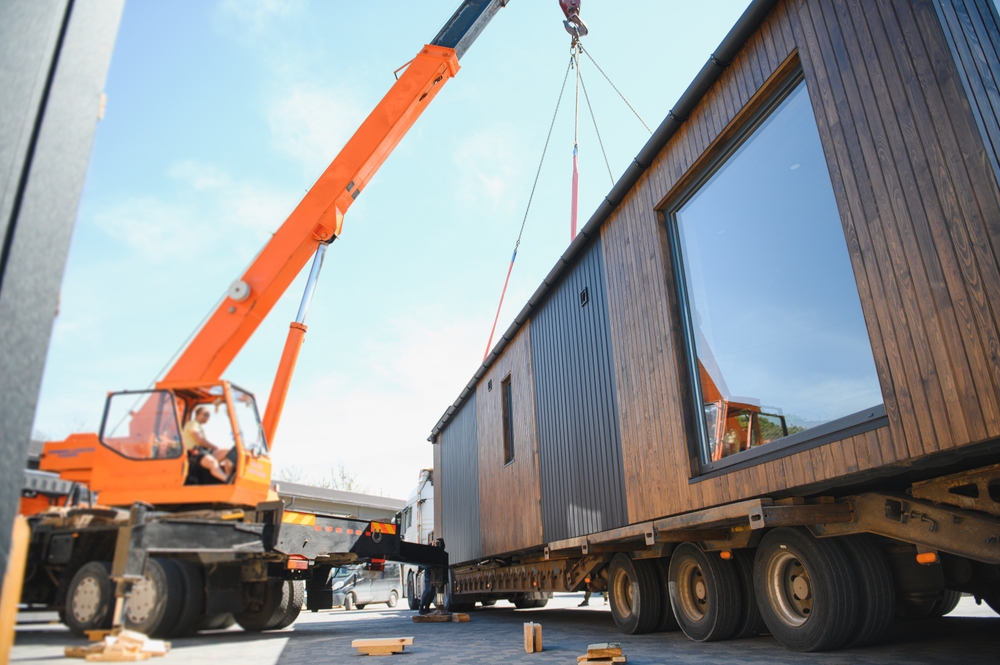
Every Evermod home is built as a complete structure at the factory, then lifted by crane onto a transport platform, driven to the buyer’s site along a route planned around its size and weight, and craned again into position on the foundation. That is how every Evermod arrives on-site in the first place. Moving an existing Evermod uses the same process, just run twice: once to lift it off its current foundation and once to place it on the next one.
This is different from what most people picture when they hear “movable home.” An Evermod isn’t wheeled off like a caravan, and it isn’t disassembled into modules and reassembled elsewhere. It’s picked up whole, moved whole, and set down whole. That’s a meaningful distinction, because it means the interior finish, the plumbing runs, the electrical wiring, and the fitted furniture generally survive the move intact. What changes is the foundation connection and the exterior utility hookups, not the home itself.
What a Relocation Actually Involves
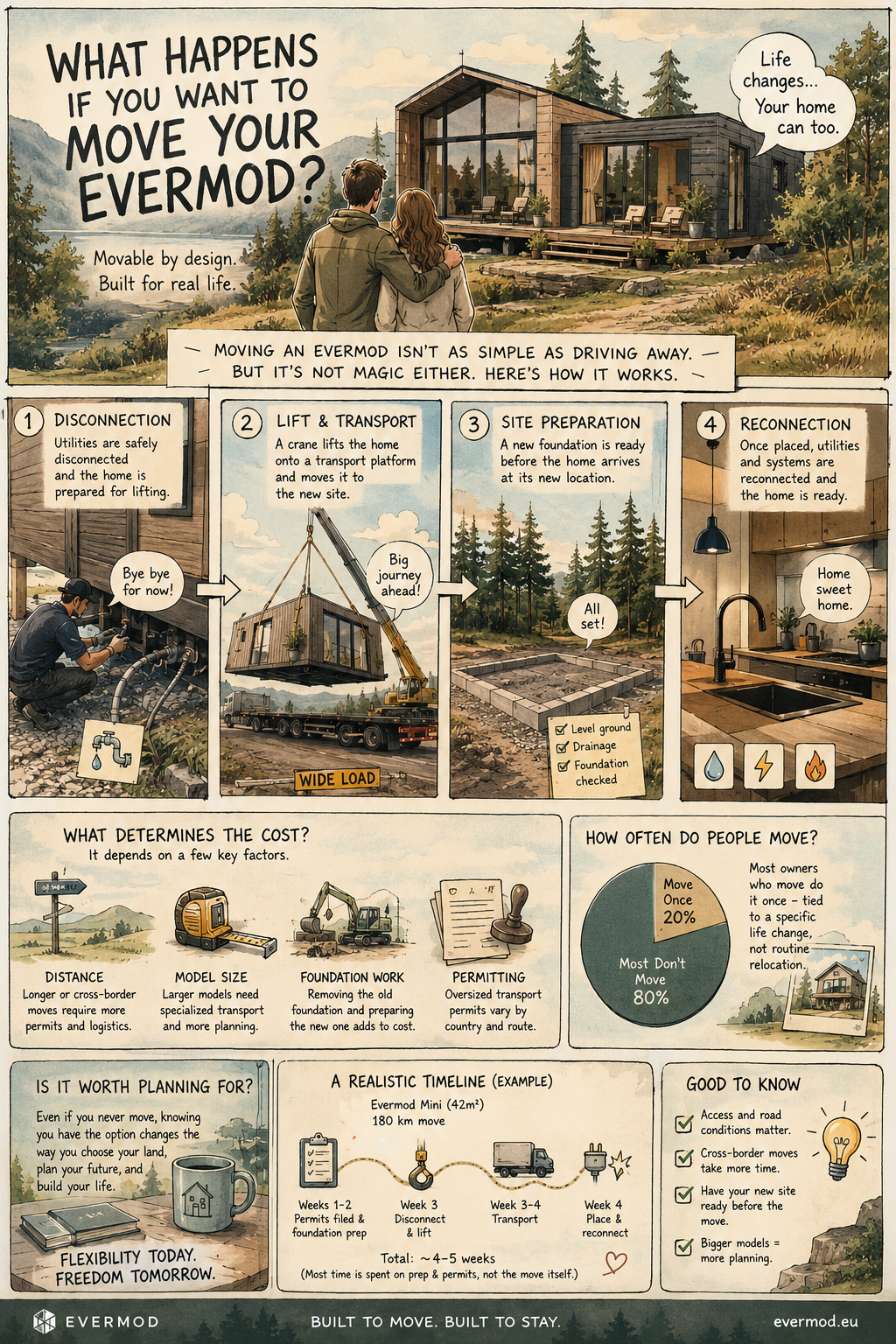
A move breaks down into four stages, and each one has its own logistics.
Disconnection at the current site. Water, electricity, wastewater, and any heating or ventilation connections that run to the exterior have to be safely disconnected before the home can be lifted. This is straightforward for most Evermod models, since the connection points are designed to be accessible rather than buried or built into the foundation permanently.
Lifting and transport. The same crane process used for delivery applies to pickup: securing the home’s lifting points, raising it onto a transport platform, and moving it along a route sized for its dimensions. This is where model size starts to matter a lot, which the next section covers.
Site preparation at the destination. A new foundation has to be ready before the home arrives, which means the same groundwork, drainage, and levelling work that any Evermod install requires. If the new site hasn’t been prepared in advance, the home sits on the transport platform (or in temporary storage) longer than necessary, adding cost.
Reconnection. Once placed, the home needs the same utility connections re-established: water, power, wastewater, and any heating system tie-ins. This is usually the fastest stage of the four, assuming the new site has utility access already run to the foundation edge.
What Determines the Cost to Move Your Modular Home
There’s no single number for “how much does it cost to move a modular home,” because the honest answer depends on four variables that interact with each other.
Distance. Transport cost scales with distance in a fairly predictable way, but it isn’t linear. Short moves (within the same region) are proportionally cheaper per kilometre than long cross-border moves, because long-distance transport often requires route permits in multiple jurisdictions, overnight stops, and pilot or escort vehicles for oversized loads.
Model size. This is the biggest cost driver after distance. An Attefall or Mini moves far more easily than a Barn Max. Larger homes may require special transport permits, road closures on certain routes, or a transport window (rather than a fixed date) depending on how local authorities schedule oversized-load movements. Smaller models can sometimes move on standard permits with minimal escort requirements.
Foundation work at both ends. Removing a home from its current foundation and preparing a compliant new one both cost money, and neither is optional. If the destination site already has groundwork done (a common scenario for people who bought land in advance), this stage is faster and cheaper. If it doesn’t, foundation prep can end up being a larger cost than the transport itself.
Permitting. A completed home moving on public roads generally falls under the EU’s rules for abnormal or oversized loads. The European Commission’s weights and dimensions framework sets the baseline limits that trigger a special permit, and its best practice guidelines for abnormal road transports specifically list a mobile house among the examples of loads these rules were written to cover. Every country, and often every municipality within a country, still runs its own approval process on top of that baseline, particularly if the destination has different zoning or planning requirements than the origin site.
Rather than quote a single figure that would be misleading across different countries and models, the honest framing is this: a relocation typically costs a meaningful fraction of the original delivered price, weighted heavily toward the smaller end for compact models moving short distances, and weighted toward the larger end for big models moving cross-border. Getting an accurate number requires knowing the specific model, the specific distance, and the condition of both sites, which is exactly the conversation worth having directly with Evermod before assuming either extreme.
How Often Do People Actually Move Their Home?
Less often than the marketing emphasis on “movable” might suggest, and that’s worth saying plainly. Most Evermod owners who chose a modular home for its flexibility never end up using that flexibility, the same way most people who buy a car with all-wheel drive never take it off-road. The option matters even when it isn’t exercised, because it changes the risk calculation at the time of purchase.
The people who do move their home tend to fall into a handful of recurring situations:
- Leasehold or temporary land arrangements. Someone who built on land they lease, or land they have permission to use for a defined period, and who always planned to relocate once that arrangement ended.
- A change in life circumstances. Downsizing further, moving closer to family, or relocating for work, where taking the home along is cheaper than selling and rebuilding.
- Land sold or repurposed. A situation where the underlying land changes hands or use, and the structure needs to move rather than be demolished.
- Inheritance or estate situations. A home that needs to move from inherited land to a location the new owner actually wants to live on.
In nearly all of these cases, the move happens once. It’s a life-event decision, not a routine one, which is part of why the logistics aren’t something most buyers think through in detail until they’re actually facing a move.
A Realistic Scenario
To make this concrete: imagine an owner with an Evermod Mini (42m²) who bought land on a five-year lease and now needs to relocate to a permanent plot roughly 180 kilometres away, within the same country.
Weeks 1–2: Foundation groundwork begins at the new site, timed to be ready before the transport date. Permits for the oversized transport route are filed, since a Mini generally falls within standard-permit thresholds for most European road authorities, keeping this stage relatively fast.
Week 3: Utility disconnection at the current site happens the day before pickup. The crane team arrives, secures the home to its lifting points, and loads it onto the transport platform.
Week 3–4: Transport follows the approved route. For a 180-kilometre move within standard permit limits, this is typically a single-day transit, though weather, road conditions, or permit scheduling can shift the exact date.
Week 4: The home arrives at the new site, where a crane team places it on the prepared foundation. Reconnection to water, power, and wastewater follows, usually within a few days assuming utility access was already run to the foundation.
Total timeline: Roughly four to five weeks from decision to reconnected home, with most of that time spent on foundation prep and permitting rather than the physical move itself, which typically takes a single day.
A larger model, a longer distance, or a cross-border move would extend this timeline meaningfully, particularly on the permitting side. A Barn Max moving between countries could easily take two to three months once every jurisdiction’s approval process is accounted for. If a local factory is involved in supporting the destination-side logistics, our piece on regional modular factories in Europe covers how proximity to production and support infrastructure can shorten these timelines.
What Could Make a Move Harder Than Expected
A few factors turn a straightforward relocation into a complicated one, and they’re worth knowing before assuming a move will be simple:
- Access constraints at either site. Narrow roads, low bridges, or tight turns near the current or destination site can rule out standard transport routes entirely, requiring a longer detour or specialised low-loader equipment.
- Cross-border moves. Different countries have different rules for what counts as an oversized load, different permit timelines, and sometimes different building code requirements at the destination, which can turn a home into something that needs re-certification on arrival.
- Unprepared destination sites. A move scheduled before the new foundation is ready creates storage costs and scheduling risk that a well-timed move avoids entirely.
- Model size at the upper end. The largest Evermod models were designed primarily for delivery to a permanent site rather than for repeat relocation, and while they can still be moved, the transport requirements scale up accordingly.
Is It Worth Planning For, Even If You Never Move?
Yes, and this is the part that tends to get lost in the marketing shorthand. The value of “movable” isn’t that most owners will move their home. It’s that the option exists without demolition, without total loss of the structure’s value, and without starting over. For someone building on land with any uncertainty attached to it, whether that’s a lease, a family arrangement, or simply not being fully certain about a location, that option is worth understanding in real terms rather than treating as an abstract selling point.
If you’re weighing a specific move, whether hypothetical or already planned, the details that actually determine cost and timeline are specific to your model, distance, and both sites involved. That’s a conversation worth having directly with Evermod rather than estimating from a general guide.
Frequently Asked Questions
Can any Evermod model be moved, or only certain ones?
Every Evermod model can technically be relocated using the same crane-and-transport process used for delivery. What changes between models is how straightforward that process is. Smaller models like the Attefall or Mini typically move within standard transport permits, while larger models like the Barn Max involve more extensive route planning and permitting, simply because of their size and weight.
Does moving the home affect the warranty or structural integrity?
The home is designed to be lifted and transported as a complete structure, which is the same handling it goes through during original delivery. As long as the move is carried out by a qualified crane and transport team following proper lifting-point procedures, the structure itself isn’t compromised by a well-executed relocation.
Do I need a new building permit at the destination, or does the original one transfer?
Building permits generally do not transfer between locations, even within the same country. The destination site typically needs its own permit and foundation approval, following that municipality’s process, which is separate from any transport permit required to move the structure itself.
Can I move the home myself, or does it have to go through Evermod?
The lifting and transport process requires specialised crane equipment and permitted haulage, which isn’t something an owner arranges independently. Coordinating a move, whether through Evermod directly or a qualified regional partner, is the practical path for handling the permitting, crane work, and transport logistics correctly.
What happens to the old foundation and site after the home is moved?
That depends on the land arrangement and local requirements. Some leasehold agreements specify that the site should be restored to its original condition, which may involve foundation removal. Other situations, particularly where the land itself is being repurposed by a new owner, leave that decision to whoever takes over the site next.