Can Foreigners Buy Land in Europe? A Country-by-Country Guide (2026)
Table of Contents
Can foreigners buy land in Europe? The answer is usually a resounding ‘yes’, but as with any international real estate venture, the devil is in the details. In reality, it’s not that simple or that difficult. It depends entirely on where you’re looking.
Some countries openly welcome foreign buyers with transparent systems and minimal restrictions. Others take a more cautious approach, especially when it comes to land use, residency, or agricultural ownership.
If you’re thinking about building a modular home in Europe, this is the first question you need to answer before anything else: Are you even allowed to buy land there? In this guide, we break it down clearly and practically, so you know exactly where you stand, and where to look next.
Can Foreigners Buy Land in Europe? The Short Answer
Yes, foreigners can buy land in most European countries. But the rules vary depending on three key factors: the country itself, your residency status, and the type of land you’re planning to purchase.
In many Western and Southern European countries, the process is straightforward and open to international buyers. Much of this is supported by the European Commission’s principles on the free movement of capital, which generally discourage discrimination against foreign investors. In other regions, however, you may encounter additional steps, such as local permits or limitations on specific land categories. Understanding these differences early on can save you time, money, and unnecessary complications later.
Countries Where Foreigners Can Easily Buy Land
Across much of Europe, buying land as a foreigner is not only possible, it’s actively encouraged.
Countries like Portugal, Spain, France, and Germany have well-established real estate markets. In France, for example, the Notaire system provides a high level of protection for both parties, making it a favorite for international buyers. The legal frameworks are clear, transactions are standardized, and there are few restrictions based on nationality.
For many buyers, this makes these countries a natural starting point. You’re not navigating unclear rules or unexpected barriers; you’re simply following a process that’s already designed to include foreign investment.
If you’re also exploring where your budget goes furthest, it’s worth pairing this with our guide on the cheapest countries to buy land in Europe, which looks specifically at affordability across the region.
What’s important here is that accessibility doesn’t always mean simplicity in every aspect, but it does mean you’re allowed to participate in the market without major obstacles.
Countries with Restrictions or Extra Steps
While much of Europe is open, there are still countries where buying land as a foreigner involves additional layers. So the question – can foreigners buy land in Europe becomes complicated.
In some cases, non-EU buyers may need approval from local authorities before completing a purchase. This isn’t necessarily a barrier, but it does introduce time, paperwork, and a need for local guidance. Often, the real hurdle isn’t your nationality, it’s the land’s zoning status.
Agricultural and Protected Land
Agricultural land is one of the most regulated categories across Europe. In countries like Poland or Hungary, for example, purchasing farmland may require local residency, farming credentials, or government approval.
Similarly, protected land, such as nature reserves or coastal zones, often comes with strict limitations on development. Even if you can legally buy it, building on it may not be possible. This is where many buyers get caught off guard. The purchase itself goes through, but the intended use of the land doesn’t.
Countries That Are More Complex for Foreign Buyers
There are also a few countries where the process is noticeably more restrictive.
Switzerland is a well-known example. Property purchases by foreigners are tightly controlled, often requiring special permits and subject to quotas depending on the region.
Denmark can also be more complex, particularly for non-residents. In some cases, you’ll need to demonstrate a ‘special connection’ to the country, such as family ties or long-term residency, before the Ministry of Justice gives you the green light.
These markets aren’t impossible, but they require a different level of preparation and, in many cases, local legal support.
What Matters More Than the Country (And Most People Miss This)
Here’s where things get interesting, and where many guides stop short. Choosing the right country is important. But it’s only part of the equation. What really determines whether your plan works is what you can actually do with the land once you own it.
Zoning laws, building permissions, access to utilities, and local planning regulations will ultimately shape what’s possible. Two plots of land in the same village can offer completely different outcomes. Owning the soil is one thing; having the right to pour a foundation is another entirely.
If you’re exploring where modular living makes the most sense, our guide to the best countries in Europe for modular living looks at not just accessibility, but practicality, where building, installing, and living is actually viable.
And if you’re already considering the next step, financing plays a role too. Regulations and land classification can directly affect your eligibility for loans, which we break down in our guide on how to finance a modular home in Europe. In other words, eligibility is just the beginning. What follows is where the real decisions are made.
The Safest Approach Before Buying Land in Europe
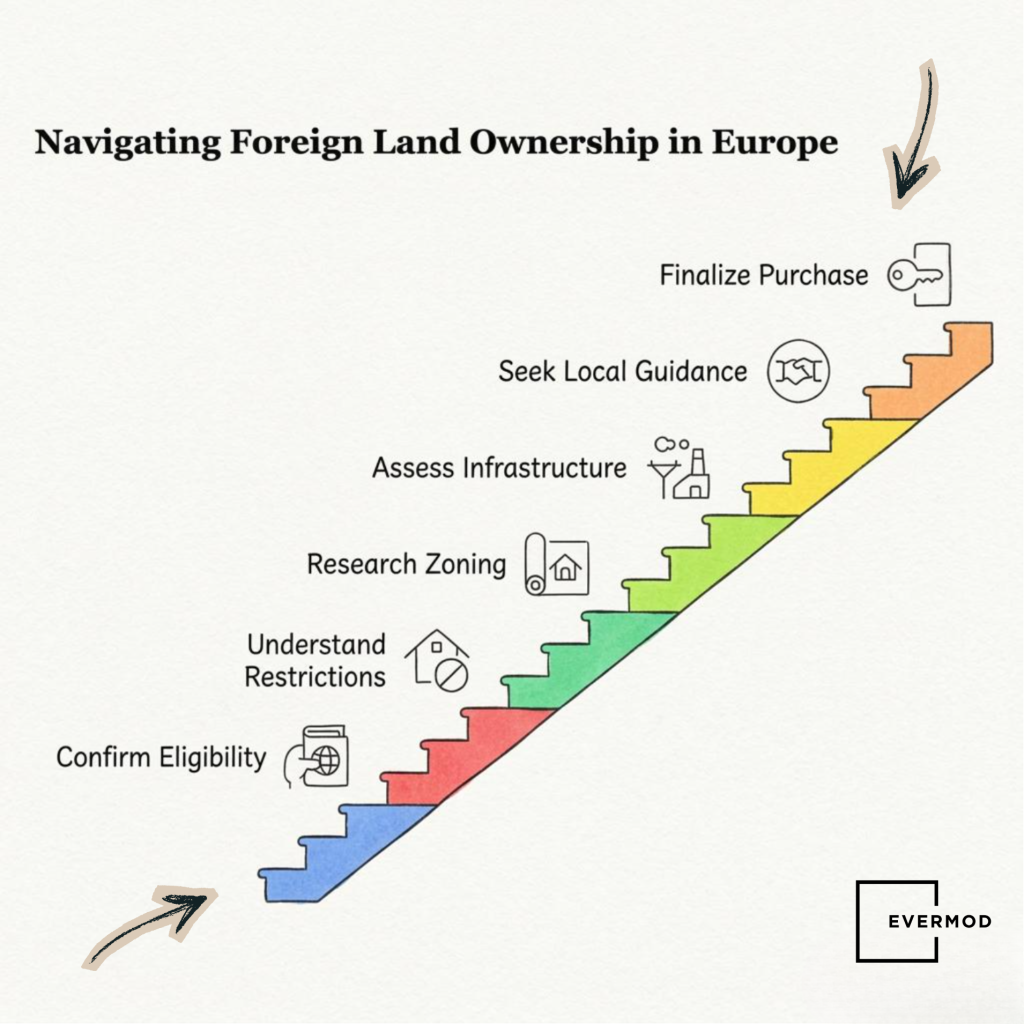
As you can see, owning land in Europe is a very real possibility for international buyers; it simply requires a bit of strategic navigation. Start by confirming that foreigners are allowed to purchase in your chosen country. From there, shift your focus to the land itself.
Local zoning regulations will determine whether residential construction is permitted. Infrastructure matters too; access to water, electricity, and roads can significantly impact both cost and feasibility.
Working with local professionals, such as real estate agents or legal advisors, is often the simplest way to navigate these details. Not because the process is impossible on your own, but because each region has its own nuances that aren’t always obvious at first glance. Essentially, you aren’t just paying for paperwork; you’re paying for their knowledge of local ‘urbanismo’, the unwritten rules of regional planning.
For a broader context on property rights and investment environments, the OECD’s data on FDI regulatory restrictiveness can provide useful background on how welcoming a specific country is to international property buyers. These resources help you understand the wider economic climate before you commit to a specific region.
Final Thoughts: Start with Eligibility, Then Move to Opportunity
Ultimately, can foreigners buy land in Europe in 2026? Absolutely. It is far more accessible than many people expect, provided you understand the specific local nuances of your chosen region.
Start with eligibility. Make sure the country you’re considering allows foreign ownership without unnecessary complications. Then move to opportunity. Compare locations, explore pricing, and think about how and where you actually want to live. Because once those two pieces align, the rest becomes much clearer, from choosing the right plot to building a home that fits your lifestyle. And that’s where the real journey begins.